HOW TO SHOOT A NETBALL

Netball is a team sport in which teams of seven players attempt to move the ball down the court and score by shooting the ball through a hoop. Players may only take one and a half steps, meaning a player can take one step and then lift their second foot if desired. The key to scoring goals with your shots is to practice proper form to shoot an arching shot with back spin on the ball.

Turn to face the goal so your shoulders, hips and feet are square to the goal, with your feet a comfortable width apart.

Rest the ball on the finger tips of your dominant hand and bend the hand back so the back of your hand is parallel to the ground.

Place your non dominant hand against the side of the ball to help aim it and control it.

Squat down while keeping your back and neck erect. The depth of the squat will vary by player, so experiment with different depths to find the least amount of squatting required for maximum height on your jump, as extra height makes your shot harder to defend.

Bring your hands back so the ball is over your head as you begin to straighten your legs to jump. Jump off the ground and extend your arms as you leave the ground.

Flick your dominant wrist forward to put backspin on the ball as you release and shoot the ball in an arcing motion. Don’t try to shoot the ball just barely high enough as it reaches the hoop. Instead, the ball should reach 1 to 2 feet above the goal at its highest point and pass through the goal on its way down.
 

HOW TO AVOID A SHOULDER INJURY FROM A BENCH PRESS

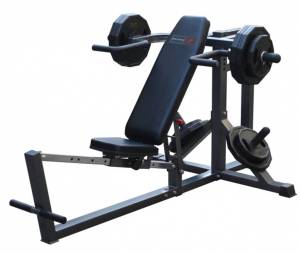
The bench press works the upper body and builds strength and muscle. Unfortunately, the bench press is also responsible for most injuries in the gym, especially in the shoulder region. Other common injuries are the wrist and neck. The reasons being that the bench press is one of the most popular pieces of equipment in the gym and is therefore performed the most and also that bench press enthusiasts fail to follow some important guidelines.

It is important to warm up before performing bench press lifts. Stretch your arms, your back and other body parts before performing any exercise. Warm up the chest, shoulder and arms by simulating the bench press with very light dumbbells. ‘Light’ is considered any weight that doesn’t impose any type of strain on the muscles. You can also just bench press the bar with no weights for 60 reps, then add light weight to the bar and perform an additional 20 reps.

Add an appropriate amount of weight and gradually increase. Don’t start bench pressing with too much weight on the bar. Find a comfortable amount of weight until you build your technique and strength. A good starting weight is not the maximum weight that you can lift, but instead the amount of weight that allows you to take the bar out of the cradle, perform 8 to 10 bench press reps and put the bar back in the cradle without assistance. You can also ask a gym associate or trainer to help you find the appropriate amount of weight to start with.

It is also essential to ask someone to spot you. Another person can help you support the bar in case you get stuck. Place your thumbs on the bar. Thumbless grips can cause the bar to slip out of your hand. Keep your glute muscles on the bench when performing the bench press. This keeps your entire body stable and helps to prevent injuries.

Keep your shoulder blades back and down on the bench. Don’t allow them to roll forward during the press. Also keep your chest up and your upper back muscles tight.

Sportsmart stocks a variety of bench presses. You can view our bench presses online or visit our stores and get expert advice from our fitness staff on how to properly use a bench press.

HOW TO RE-GRIP A CRICKET BAT

A cricket bat’s rubber grip will never last as long as the bat. Even one long session, producing more than 50 runs and lasting two or three hours might wear out a grip. Grips vary in thickness and consistency and come in a variety of colours.

Firstly, you will need to assemble your equipment i.e. a gripping cone and the new grip. The gripping cone is a piece of wood a few inches longer than the handle. The top is narrower than the bat handle and the end, a metal cup is wider and fits over the top of the bat handle. Remove the old grip and dust the bare handle with talcum powder.

Put the new grip on the cone, with the surface facing outward. Roll the grip up from the bottom until it is completely rolled up.

Take it off the cone, turn it upside down and put the grip back on the cone. Roll it to the bottom of the cone. Put the cone over the bat handle and roll the grip down the handle. Some rubber will still hang over. Hold the bat firmly and tap the grip down until it is in place.

Secure the bottom of the grip to the bat’s shoulders with electrical tape.

HOW TO START A BASIC WORKOUT PROGRAM

Working out seems to be on everyone’s to do list but does not always make it in to our daily routine. This article will show you how to start a basic workout program and will teach you to start slow and establish your routine.

Firstly, make a plan. Figure out which four days of the week you can make room for 45 minutes of exercise. Every other day of the week usually works out best. Plan out which days and at what times you will workout.

Outline the exercises you will start with. Pick five exercises to do each day you workout. Each one of these exercises will need to set a goal of reps. For example, if its push ups, try to do 6 reps. Then repeat those reps three times for each exercise. Some of the exercises you can do without equipment are push ups, sit ups, crunches, jumping jacks and running.

One of your five exercises should include cardio. Every day that you workout you should have at least one of your exercises be cardio. You can run or walk. You want to start with at least ten minutes of cardio.

Record your progress and increase your activity and reps. As you continue to workout, write down what you do every day. This way you can record your progress and plan to increase your activity. Once you get through the first couple of months, you should be seeing progress in your reps and results.

REVIEW: ASICS GEL ADVANCE 4 CRICKET SHOE

The Asics Gel Advance 4 cricket shoe is known for being extremely lightweight. If you’re after the ultimate performing cricket shoe, than look no further than the Asics Gel Advance 4 cricket shoe.

Featuring a Solyte midsole and a new injection PU outsole, the Gel Advance 4 is lighter than traditional rubber outsoles and gives players a more supportive base.

The Asics Gel Advance 4 cricket shoes are primarily used for batting and come with a full compliment of screw in metal and PU soft studs.

In addition, the upper fit has been enhanced with the introduction of the Clutch Collar. Also, the P-Guard on the toe box ensures protection against toe drag.

The Asics Gel Advance 4 cricket shoes are now available at Sportsmart. You can view them online or visit our stores to try a pair on for yourself.

WORKOUTS THAT IMPROVE PITCHING SPEED

Pitching a softball at a high rate of speed with accuracy is a skill that pitchers need to constantly work on. Softball pitchers must have in their routine an exercise regimen that includes workouts aimed specifically at improving pitching speed.

Pitching velocity relies on coordination throughout many parts of the body and having strong, stable legs is essential. The ability to drive the leg into the ground with force has a significant effect on the speed of the ball. Therefore, pitcher workouts should include exercises that will help improve leg strength such as lunges, squats, calf raises, leg presses and leg curls.

Although some pitchers and pitching coaches shy away from heavy upper body workouts because they fear they might injure their throwing arm, pitchers who include upper body resistance training can increase their pitching speed. In fact, stronger shoulder muscles can significantly help to prevent injuries. Some exercises include, bench presses, rowing machine work and push ups.

In addition to working out major muscle groups, there are some resistance exercises that will help the pitcher increase velocity. Pitchers can pitch with a weighted baseball. This will make a regulation ball seem easier to release at higher speeds.

BASKETBALL SHOT TRAINING

Basketball shot training is something that must be performed on a daily basis to get the most out of your ability. Shooting the ball effectively is all about repeatedly practicing the correct fundamentals. The more repetitions you get shooting the ball correctly, the more chance you have of seeing positive results when they count.

Balance is a crucial part of basketball shot training. The player must be balanced on their feet to have a chance of making the shot. A ball is shot from the feet upwards, so if your feet are out of balance, the rest of your body will be too. Being on balance for basketball shot training should include the weight being evenly distributed on each foot with a slight bit more on the balls of the feet.

Having the shooting elbow in is a must when working on your basketball shot. The elbow should be tucked tightly against the body pointing toward the ground. The elbow should not be pointing out to the side. Having the elbow out to the side will cause the shooter to push the ball to one side or the other. When the elbow is in, the ball can more easily be shot in a straight line.

The shoulders of the shooter must be squared to the rim when training for your basketball shot. The shooter should be lined up so the rim is between the shoulders. This will ensure the body is true and square and will give the ball the best chance of going in. If the shoulders are not square the ball is more likely to be shot too far to one side or the other of the rim.

Your eyes should be focused on the rim, not the ball, with every shot that is taken during training. Focusing the eyes on the rim allows the shooter to concentrate on one fixed point instead of focusing on the ball which is constantly moving after it is released.

The follow through is to be high and it should be held until the ball hits the rim. The follow through starts as soon as the ball leaves the shooters hands and is the last point of contact the player has with the ball. The hand should end up above the head with the wrist bent and with all fingers pointing downwards. A good follow through can compensate for any deficiencies elsewhere in the shot.

HOW TO PLACE A GOALIE FOR A CORNER KICK IN SOCCER

The placement of your goalie during corner kicks will have a direct effect on the results of the game. Coaches and goalies need to be able to read the other team and react accordingly, advancing and defending the goal based on the type of corner kick and the way the offense is running the ball.

Place the goalie to receive a far post corner kick just to the side of the goal post, at the point farthest away from the corner the ball is being kicked in from. During a far post corner kick, the ball will be long flighted toward that further goal post with runners ready to kick into the goal.

Position the goalie close to the goal on the side facing the kicker during a near post corner kick. This type of corner kick sets up a runner to deflect the corner kick into the goal and is a fast paced play, making it harder for the goalie to read the play.

Station the goalie centrally to receive a short corner kick. This kick is designed to have the corner kick received by another player and passed to a third player. It is highly effective at changing the pace of the game and throwing off the rhythm of the defense.

The best way to learn how to position the goalie during corner kicks is to drill corner kicks regularly. This not only helps prepare the goalie to defend against corner kicks, but also helps the goalie learn to read plays and the field more effectively.

HOW TO CATCH A CRICKET BALL

The most important task of a fielding side in cricket is taking catches. You can’t win matches without taking catches in cricket. Catching a cricket ball is something all cricket players should learn.

Catching the ball when the fielder is standing in the infield is known as an infield catch. There are two positions for a fielder in cricket. One is infield and the other is outfield. A fielder can take catches in both positions. The infield positions are the slip, the point, cover and square leg region. The infield is near the pitch and close to the batsman. Sitting catches or sitters that need little or no movement are taken in the infield. The ball will come to the infield fielder flat and fast.

Catching in the outfield involves taking a catch far away from the batsman. These catches are sometimes taken on the boundary line of the field. Fielders will have to run a distance to take the catch. The long on, long off, third man, deep and fine leg are the outfield positions where fielders are placed to get a catch.

Catching a cricket ball with the fingers down catch or the reverse cup is usually an outfield catching method. The palms of the fielder are positioned in a form of a circle forming a cup. The fingers of the fielder are positioned in a downward direction. This makes it comfortable to catch the cricket ball that comes at excessive speed from the sky. A fielder can jump or take the catch while running using the fingers down catch.

Catching a ball with the fingers up is also called the orthodox cup. Here the fielder holds his hands with fingers joined and crossing at their base to form a regular cup. This catch is for close call catches from the infield. The fielder can keep his cupped fingers against his body and take the catch easily. Flat yet powerful hits to fielders in infield positions can fetch wickets using this catching method.

It is important to closely monitor the body language of the batsmen as soon as the ball leaves the hand of the bowler. The eye should never leave the ball. Practice makes perfect and snatching the ball instead of catching the ball will result in injured fingers.

HOW TO SCORE A PENALTY KICK IN SOCCER

Penalty kicks occur in soccer when one player trips another player in the box. What happens next is a one-on-one, where a player shoots from around 11 meters away from the goal on the goalie.

You have to be confident. Even before you approach the ball, you need to know where you are going to shoot the ball. You have to be borderline cocky and have confidence in yourself that the shot is going in even before you kick it.

You don’t want to give away where you are putting the shot. When you run, don’t open your hips because it will show where you are aiming the ball. The whole process must be quick and straight on so that you don’t give away the advantage of being an offense.

Never look at the goalie. Look at the ball the entire time, look at the goal and know where you are going to put it. Don’t deviate from your plan. You don’t want to look at the goalie because you might give something away about where you are going to kick it.

The actual shot is actually one of the least important parts of the penalty kick, believe it or not. What is important is being confident and knowing where you are going to place the ball. As for the actual kick, keep it low and direct it to toward the side netting. If the ball touches the side netting, the goalie won’t be able to save the shot. If you shoot high in the air, the goalie will have a chance to jump at it.