HOW TO TAKE UP TENNIS

The winner of Sportsmart and Wilson’s tennis sponsorship program, Scott Lyons, provides regular blog articles on his favourite topic – tennis …

Have you ever watched tennis on TV or driven past your local courts and wondered, “Gee, I would really like to play tennis?” Have you ever put it off through self-doubt of not being good enough, or perhaps because there is nobody to play with at your level? Well here is exactly what you need to do!

The great thing about tennis is that it is a game that can be played by all people, regardless of gender or age, and regardless of skill level. You don’t often see 80 year olds playing rugby, or people trying backflips at their first gymnastics lesson, but tennis is different. Anyone can play, and remember, it is all about having a bit of fun.

So what do you need to get started? Well first there is the obvious stuff, such as equipment! Of course, you will need a racquet. If you have never played in your life then maybe you can look out for an old racquet from a friend, otherwise you can consider buying a brand new, good looking racquet from Sportsmart! Sportsmart offers tennis racquets to cater for every player, so even if you are just starting out, there is a racquet out there that is just for you. You may also want to grab a can of balls while you are here. It is also a requirement at most tennis courts to wear appropriate tennis shoes with the correct sole. Sportsmart also sell great tennis shoes at a fantastic price, so come in and have a look.

Now with all your gear, where do you play? If you have a friend that you can play against then that is great, but if not, the best solution is to join a tennis club! In general, tennis clubs give you free access to courts, organised social tennis and a new social network of tennis players, some starting out just like you. So don’t be shy, and give it a go!

However, what if it is not yourself, but your child that wants to take up tennis? How do you go about arranging this? Before you worry about equipment and everything else, the first thing you should do is visit a club near you and make contact with a coach. Coaches often run small group sessions for small kids which are fun, interactive and develop tennis skills. And of course, coaching is not limited to kids, but adults taking up tennis should definitely consider contacting a coach too.

Tennis is truly a fantastic sport that you can enjoy for a lifetime, so go and play for yourself and you definitely won’t regret it!

HOW TO BEND A FREE KICK IN SOCCER

We have all seen David Beckham’s notorious bend on the ball but how does he do it? What seems impossible to do is actually an attainable skill.

When placing the ball, make sure it sits high on the grass or turf. If you watch professional players, they usually toss the ball into place with a little backspin. This both facilitates a quick restart of play and leaves the ball in a high position so that you can strike the lower hemisphere of the ball cleanly.

The key to bending the ball is how you strike the ball. Depending on the kind of lift you want on the ball, it should be struck somewhere on the lower hemisphere. In order to get the ball spinning, you should strike the ball slightly off centre with a lot of force.

The follow through is almost as important as the strike itself. Although you should strike the ball slightly off centre, the follow through on the kick should carry your leg straight through (and well past) the ball. Good form for a free kick is similar to that of a strong strike on goal: toes pointed, knee and head over the ball. The difference for a bending ball is that it should be played slightly to the side of your laces (instead of straight on for a low driven shot). The side you use depends on whether you use the outside or inside of your foot as well as where you want the ball to bend. For example, if you are right footed and you strike the ball with the outside of your foot, the ball will bend to the left.

It is important to remember that the ball must be hit with a lot of force. What makes a ball spin is its forward velocity as well as the speed of its revolution. With practice, you will be able to gauge how much you should bend the ball and how to position your free kick so that it curls past the defenders and meets an attacking head or foot. A bent ball is also very deceiving for goal keepers, because it can start to go wide and then head straight for the corner.

SPORTSMART CRANBOURNE NOW OPEN!

Sportsmart is proud to announce the grand opening of Sportsmart Cranbourne!

Our new store is located at Shop 20, Cranbourne Homemaker Centre, Corner South Gippsland Hwy and Thompsons Rd, Cranbourne.

To celebrate our grand opening we are having a massive opening sale!

Save on the latest running shoes from Asics, New Balance and Brooks!

Save $1000 on the York Rival treadmill and save $150 on the Ringmaster Fury exercise bike!

Save $270 on the Dunlop Twin Roller table tennis table!

Click here to view more of our Cranbourne specials online!

Today only, thanks to our friends at adidas we are inviting our loyal customers to come and meet AFL superstars Bryce Gibbs and Dustin Martin! From 5:30pm-6:30pm, Bryce and Dustin will be there to meet all fans and sign some autographs! There will also be giveaways and prizes for some lucky customers!

Visit Sportsmart Cranbourne today!

HOW TO CHOOSE BASIC BOXING EQUIPMENT

Boxing requires specific safety equipment to protect you from injury. Using the equipment properly helps you to succeed in the sport and reduce your chance of injury. When you begin boxing, you’ll need to know how to select and use basic boxing equipment to meet your needs.

Wrap your hands before you put your boxing gloves on to help protect your knuckles and small bones in your hands and wrists. Have someone help you do this. Ensure that your wrists and hands are protected but aren’t wrapped so tightly that it comprises your circulation.

Choose boxing gloves according to the type of training you are doing. Gloves are available in different styles and weights. Gloves for speed bags are lighter and have less padding than the heavier sparring and boxing gloves. Heavier gloves are safer for you and your opponent. Try different styles to make sure they feel comfortable and secure around your hand with wrapping in place.

Select shoes specifically made for working out in the boxing ring. They are made out of lightweight materials for ease of movement but have enough traction so you can move quickly without slipping.

Wear a boxing cup protector, which offers more coverage than basic sports cup protectors. The hips, abdomen and groin have more protection from punches.

Finally, protect your teeth with a mouth guard. Choose from a wide variety of mouth guards to find one that is right for you. You will find that some are basic while others will mould to the shape of your mouth and provide shock absorption. It depends on what is most comfortable for you.

Sportsmart stocks a variety of boxing equipment to suit your boxing needs. You can view our boxing range online or visit our stores to get expert advice from our fitness staff and try out the equipment for yourself.

HOW TO GET KIDS EXCITED ABOUT EXERCISE

If you are able to get kids excited about exercise at an early age, they will consider it a treat rather than hard work. The way to accomplish this is to turn physical activity into a game so your children will ‘play’.

Yoga and other stretching exercises are great ways to warm up for other exercises such as running, and playing sport. Yoga exercises are also good on their own, they increase flexibility and concentration in both children and adults.

You can make yoga poses fun for kids by introducing them with informal names i.e. a balancing position is called ‘tree pose’ and back exercises are ‘cat’ and ‘cow’.

Cycling is another exercise opportunity as it is a great way for families to have a fun time together. Get kids interested by creating a race atmosphere. Set a course, sound a starter and time children to the finish line. On family rides, include a goal such as stopping for ice cream half way through. This alone will get kids pretty excited!

Organised sports is something many children naturally have an interest in. Getting kids involved in sports such as soccer, basketball, and football are great to give kids a bit of regular exercise as well as make new friends and have fun. Individual sports such as swimming or gymnastics are also a good option and some kids may be more comfortable in these types of sports rather than in a team atmosphere. Evaluate your options and choose a sport which is suited to your child.

ABUSE IN FOOTBALL…WHY WE HAVE NO NEED FOR IT

The winner of  the Sportsmart AFL sponsorship program, Michael Shmerling, provides regular blog articles on his favourite topic – football …

As a player of the last 15years and a current junior coach, I’ve seen and heard my fair share of abuse. Being apart of a Jewish football team has its costs, and sometimes they are on the wrong side of sportsmanship. But now in the 21st Century, you’d think that such behaviour wouldn’t exist as such words of hatred would have been thrown out with olden day football. Well as we have learnt through some high profile incidents this year, abuse and sledging has been taken to a whole new level, but why?

Abuse and sledging is apart of our game, no question about it, but it’s in those words that now have a new meaning and a new strength to do more damage to an individual and/or team that has made headlines. What happened to the old saying “chewy on ya boot” or “my grandma can kick this”. What ever happened to the footy sledging that was harmless and only involved in game banter.

Football abuse and banter has taken a turn for the worse in recent months with great affect on the great game. Racist and abusive taunting are ruining our game, well done to Lyndon Dunn for taking a stand and saying that it’s not on. The AFL handled it right and so have the West Coast Eagles.

Here is my message to all footballers and supporters out there,

SLEDGE RIGHT, DON’T ABUSE AND TAUNT AS KARMA WILL ALWAYS BITE BACK.

HOW TO CARE FOR YOUR GOLF SHOES

Most good quality golf shoes are made of full-grain leather. Golfers require optimum support and comfort from their shoes and need to understand how to take care of their shoes to get the most out of them and keep them looking their best.

Keep your golf shoes clean and free of dirt and pesticides by using a clean, soft towel to wipe them down after each round. Wiping your shoes after each use will help to keep them free of moisture if you play during or after a rainfall.

It is also important to replace your spikes when they begin to wear down. Check the bottom of your golf shoes after each use for loose or warn spikes. Twist the old spike out by turning it counter clockwise and set a new one in its place with clockwise turns.

Clean the bottom of your shoes after you wear them. Rub a hand bristled brush back and forth along the bottom. Make sure that you clean in between each spike so that you remove dirt and debris.

Finally, apply a leather balm or leather protector to your shoes. Read the instructions on the packaging to ensure that you are doing it correctly and re-apply when needed.

HOW TO BUY A CRICKET BAT

Buying a cricket bat takes an understanding of the components of the bat and how it is put together. Cricket is a very popular game and having the right equipment is important. Picking a good cricket is simple using our guide.

Know the construction and size of a cricket bat. The overall length of a bat is no more than 38 inches. It has two parts: the blade and the handle. The handle of a good cricket bat is the most expensive part of the bat and it takes up to 20 separate pieces of cane with rubber layers glued into it to act as shock absorbers. It is also important to remember to select the model of cricket bat that most suitably fits your style of play, for example the Kookaburra CCX range of cricket bats is designed for ‘aggressive destroyers.’

Choose the handle length and diameter that fits your height and hand size. The handle can be long or short as long as the overall length of the bat does not exceed the 38 inch limit. The best way to determine if a bat is the right size, is to stand in your batting stance and rest the toe of the bat against the outside of your back foot, lean the cricket bat so that the top of the handle rests next to the inside groin of your front leg. If the bat is of the right size it should rest comfortably on the inside groin of your front leg.

Decide which type of willow you want for the blade. The best bats are made of English willow, a soft fibrous wood with excellent rebound qualities when the ball strikes the middle of the blade. Lower grade bats are made from Kashmir willow which is a harder more brittle wood. Look for compressed curved bat blades, never shaved bats as they are not as good.

Test the performance of the bat by bouncing a red leather cricket ball on the blade several times while holding it by the handle. On a good blade, the ball will bounce high or spring. On a blade of lesser quality, the ball will bounce lower and seem dead. Be sure the blade contains no knots as these are dead areas on the bat.

Sportsmart stocks a variety of cricket bats and accessories that you can view online. You can also visit our stores to get expert advice from our bat ‘n’ ball staff on choosing a cricket bat that is right for you. We also offer our customers a cricket bat preparation service. Simply ask our staff for more details.

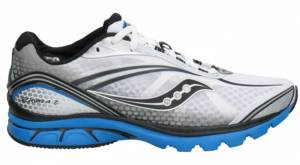
SAUCONY PROGRID KINVARA 2 RUNNING SHOES

The Saucony Progrid Kinvara running shoes feature minimal construction and will fit you like a glove. These running shoes are both lightweight and very responsive when you run. They also allow your feet to move through the gait cycle uninhibited.

The memory foam heel pods add customised cushioning and the endoskeleton synthetic lockdown uses synthetic overlays that are located at the midfoot and wrap the upper for a secure and snug fit. The EVA sockliner offers additional cushioning directly under the foot.

The design of the Saucony Progrid Kinvara’s is specific to what you need, the lower heel to toe ration is built to serve your natural stride which can really matter at the end of a run. The EVA plus midsole provides shock absorption and protects your feet against impact. If you’re looking for a training shoe to use on a daily basis that is ideal for the neutral runner, look no further than the Saucony Progrid Kinvara running shoes.

The Saucony Progrid Kinvara running shoes are now available at Sportsmart as part of our new Performance Lifestyle footwear range. You can view the Suacony Progrid Kinvara running shoes online or visit our stores to try a pair on for yourself.

CONTROLLING A SOCCER BALL

There are two types of control, receiving and trapping. Receiving means directing the ball into space away from the body. Trapping is stopping the ball right at your feet.

Receiving

Receiving is useful when running into space. Try to make contact with the middle or top part of the ball. Tap it lightly in the direction you want to go. Good soccer players can settle the ball in open space, even when they are under pressure.

Trapping

Trapping is typically used when the ball is going too fast to redirect with your first touch. The important thing to remember here is to try to stay loose and on your toes. You can’t adjust to the ball when you are flat footed. Try to keep your hips open, facing the direction from where the ball is coming. Put your foot in the path of the ball and cushion it.

The easiest way to practice control is with a partner. Your partner can throw the ball to you, after settling it with a single, clean touch, pass it back. If you do not have a partner you can use a wall. Stand about 3-5 meters away from the wall and knock the ball against it. You then trap or receive the ball as it comes back to you. This exercise allows you to work on both your kicking and control.

There are various methods of controlling a soccer ball, they include:

–          Inside the foot: Your supporting foot must be planted 45-90 degrees in relation to the path of the ball. Don’t plant it flat, instead keep your weight on your toes. You should intercept the ball with the arch of your free foot.

–          Outside the foot: This technique is useful when the ball is coming in from the side. Rather than turning your body into its path you can control it using the outside of your foot.

–          Sole of the foot: Simply put your foot on the ball with your toes raised slightly above your heel. Some players use it to stop right before changing direction.

–          Instep: This technique is useful when the ball is falling from a steep angle. Don’t just wait for the ball to arrive, stay on your toes and lock your eyes on it. Before the ball arrives, stretch the ankle of your controlling foot. Try to cushion the ball using the area around your shoelaces.

–          Thigh: The thigh is especially useful when you want to trap the ball. Cushioning the ball with the thigh can be done for both rising and dropping balls. Make sure you position yourself properly before trapping the ball.

–          Chest: The chest provides the largest surface area for trapping or receiving the ball. When using it for control, stretch out your arms and flex your muscles.

–          Head: Set up your body just as if you’re about to head the ball. Instead of heading it, simply intercept its path using the surface area on your forehead.