
Category: NETBALL
HOW TO SHOOT A NETBALL
Netball is a team sport in which teams of seven players attempt to move the ball down the court and score by shooting the ball through a hoop. Players may only take one and a half steps, meaning a player can take one step and then lift their second foot if desired. The key to scoring goals with your shots is to practice proper form to shoot an arching shot with back spin on the ball.
Turn to face the goal so your shoulders, hips and feet are square to the goal, with your feet a comfortable width apart.
Rest the ball on the finger tips of your dominant hand and bend the hand back so the back of your hand is parallel to the ground.
Place your non dominant hand against the side of the ball to help aim it and control it.
Squat down while keeping your back and neck erect. The depth of the squat will vary by player, so experiment with different depths to find the least amount of squatting required for maximum height on your jump, as extra height makes your shot harder to defend.
Bring your hands back so the ball is over your head as you begin to straighten your legs to jump. Jump off the ground and extend your arms as you leave the ground.
Flick your dominant wrist forward to put backspin on the ball as you release and shoot the ball in an arcing motion. Don’t try to shoot the ball just barely high enough as it reaches the hoop. Instead, the ball should reach 1 to 2 feet above the goal at its highest point and pass through the goal on its way down.
ATTACKING IN NETBALL
Attacking is crucial in netball. To attack you need to have high levels of coordination, be aware of the situation around you and have skills in developing good tactics on the court. Great players have the ability to create an attack out of nothing except having the ball and are able to do this from any position on the court.
An effective attack locates and exploits the weaknesses in defence and is able to turn a defensive situation into an attacking situation. The attacker must be able to dictate the play and the opposition has no choice but to react. This will mean that they are too busy to focus on scoring.
The most lethal attack is one that is able to throw the defence off balance. Typical attacks include:
- A long pass into an open zone
- A multi player attack which pins down the opposition in defensive groups
- The sudden attack from defence which upends the field positions
An attack needs to be planned, so that other players on the team are able to support it. Mixing up your passes can help your team to control the pace of the game and out smart the opposition. Try not to always look for the long pass or throwing from the wing, try cutting inside and creating a short bounce pass.
REVIEW: ASICS GEL NETBURNER SUPER NETBALL SHOES
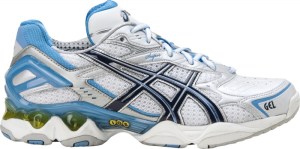
The Asics Gel Netburner Super netball shoes will exceed the expectations of all netballers. Both the midsole and outsole is the most advanced technology used in netball shoes. The Kinsei running technology in the midsole – for those who don’t know, this technology is based on that used in the Asics Gel-Kinsei running shoes – combined with a Clutch Counter System gives you outstanding midfoot rigidity and fit making the Asics Gel Netburner Super netball shoes top of the range.
The newly designed outsole consists of herringbone making the grip outstanding on the netball court. The pivot point on the forefoot of the shoe allows you to make quick movements and change directions quickly. The stitched toe cap counters toe drag and toe spring gives you great release at toe off. The forefoot of the shoe features ‘double’ twist gel as well as gel in the rearfoot for maximum cushioning.
The Asics Gel Netburner Super is suitable for netball players at all skill levels and combines the latest in Asics technology to provide you with a durable, comfortable and high performing shoe in competition. With no visible downside or disadvantages these shoes will give you the competitive advantage on match day.
Sportsmart currently stocks the Asics Gel Netburner Super as well as many other netball shoes for both junior and senior players. You can view our netball shoes online or come into our stores to get expert advice on choosing the right netball shoes for your sporting needs.
KIDS FOOTWEAR BUYING GUIDE: NETBALL SHOES
by Gerrard Woods, Director, Sportsmart
Sportsmart stocks a wide range of children’s footwear for a variety of sports.
Our buying guides provide some useful information to help parents know what features to look for in shoes for their kids.
Our footwear staff can help with further information and fitting in-store, to help ensure kids get the best shoes for their needs.
NETBALL SHOES
Cushioning
The material between the upper and the sole of the shoe.
Cushioning provides shock absorption, which is important for comfort and protection against ground impact –
i.e. running and jumping.
Ankle support
Where the upper is raised around the collar of the shoe to provide support to the ankle.
Provides stability to the heel and mid-foot, which will reduce stress to kids’ feet and legs.
Outsole grip
The bottom of the shoe that is in contact with the court surface.
Good grip is important for movement and ensures that the shoes will last longer. Netball shoes have more
durable outsoles than normal running shoes.
NETBALL TRAINING TIP: WARMING UP
Personal trainer, Tavia Ambler
Performing a sufficient warm up in netball is incredibly important as it helps to ensure the player’s body is ‘game ready’, reducing injury risk during the game. It also helps netball players to become focused both individually and as a team.
Warm up
- Shuttle run. Use the ‘third’ lines on the court as markers to set up a shuttle run. Jog to the first line and back. Complete this twice. Repeat the shuttle run again but sprint to the first line and jog back. Finally, repeat sprinting the whole way.
- Shuttle run with a twist. Still using the shuttle run set up, this time doing side-step, bottom kicks and high-knees and finally finishing with fast jogging on the spot followed by max sprint to the end and back.
- Quick stretch (5-10 minutes).
- Passing drills. In pairs, complete 25 shoulder passes each (using both right and left arm), 25 over-head passes, 25 chest passes, 25 bounce passes (right and left) and 15 lobs.
- Four corners. Distribute players into each corner of the middle third. Start with one ball and, as a player leads out, pass the ball. Once this gets easier add another ball, and possibly even three balls.
- Circle work. This is a great one to finish with as it gets the whole team involved and gives each player a chance to get them prepared for their position. Have the shooters and defenders in the goal circle, with C, WA and WD around the outside. The Wings and Centre need to pass the ball around and then on to the shooters (while the defenders have to try to intercept it). When the shooters get the ball they need to try to shoot a goal. Continue for only 5-10 minutes as you don’t want the players to get too tired before the game.
HOW TO: PERFECT YOUR ONE-HANDED SHOULDER PASS
The one-handed shoulder pass is generally a long, straight pass, and is great for covering distance. When performed well, it can elude any pesky defenders standing in between you and your fellow team members, and can get the ball to your shooting end with speed. While the technique may seem uncomplicated, getting it absolutely right can help to minimise unforced errors and, ultimately, lead to a better performance on court.
Preparation
For power and control, stand with your feet shoulder-width apart. Bend your knees for maximum control and to allow your body to ‘spring’ up after the pass. Cradle the ball in your throwing hand, resting it on your fingertips.
Pass
Take your hand with the ball back, at shoulder height, past your body. Step forward with your opposite foot. Rotate your hips as you whip the ball through, bringing your weight forward onto your front foot and fully extending your throwing arm. Keep your eye on the target, using your shoulder, elbow, wrist and fingers to direct the pass. The pass should be hard, fast and direct.
Practice
With a partner, in a grid space, practice:
• 10 throws with your right hand
• 10 throws with your left hand
Encourage children to:
• throw the ball as they would a tennis ball
• step onto the foot on the opposite side of their body to the throwing arm
• step towards the catcher as they throw.
Karen Byers, Sportsmart
NETBALL TRAINING TIP: UPPER BODY STRENGTH
Netball requires a strong upper body so that players can throw the ball with great strength, distance and precision as well as being able to stand up tall and hold their ground and position throughout the entire game.
This is a great upper body circuit that will help develop muscular endurance (toning and strengthening) without causing players to bulk too much (not required for netballers). Repeat all sets 2–3 times with either 15 or 20 repetitions for each, depending on strength and time.
SUPERSET 1
• Dumbbell bicep curl (using 3–5kg dumbbells)
• Standing dumbbell shoulder press (using 3–5kg dumbbells)
• Standing dumbbell fly (using 3–5kg dumbbells)
SUPERSET 2
• Barbell bench press (using 3–5kg dumbbells)
• Dumbbell upright row (using 3–5kg dumbbells). Place your hands (holding the dumbbells) straight in front of you with palms close to your legs. Keep the weights together and pull your elbows up towards your ears. Your elbows should remain higher, with your weights just above chest height. Repeat.
• Front raise with dumbbells (using 3–5kg dumbbells). Begin in the same position as the upright row, though this time bring the weights up in front of you. Elbows should have a slight bend in them (arms are nearly straight). Bring the weights to shoulder height, then move them back down and repeat.
SUPEREST 3
• Tricep dip on bench
• Push-ups (either on knees or toes depending on shoulder strength)
Personal trainer, Tavia Ambler
(www.taviastraining.com.au)
COMPRESSION GARMENTS
Sportsmart Clothing Manager, Liam Collins
Want to get an edge over your next opponent plus perform better and recover faster for your next game? Sportsmart may have the solution for you: compression garments.
We carry a range of different compression garments, which can help with this goal. Compression garments accelerate blood flow and oxygen to the muscles, helping to eliminate lactic acid to allow you to compete at a higher rate for longer. Compression garments also draw moisture away from the skin, resulting in a dry and comfortable netballer.
As compression garments improve circulation, this also allows them to optimise body temperature in both hot and cold environments. Wear them during training, while playing, and for post-match recovery.
You may have seen the Melbourne Vixens netball team, whot won the 2009 championship, wearing compression garments throughout the season. If it’s good enough for them, it’s good enough for you!
So, reward yourself. Check out Sportsmart’s compression garments when you are next in store.
We stock Skins, Under Armour, Performax and Nike Pro compression garments, with options including full length tights, capris (3/4 length), shorts, short-sleeve tops and long-sleeve tops.
HOW TO: SHOOT A NETBALL
Netball is a game of skill, pace and flexibility – but one very important aspect is shooting accuracy. Whether you are a Goal Attack or Goal Shooter, or you are just keen to try your hand at shooting, breaking the motion down into steps allows you to focus on technique at each point in the shot. Here are five basic steps for shooting a netball:
1. Align your body to the netball post so your whole body faces the post
2. Ensure your feet are shoulder-width apart – this helps with balance
3. Hold the ball in both your hands and stretch your arms straight above your head
4. Bend your knees and elbows then release the ball and push it upwards as you straighten
5. Flick with your wrists as you let go of the ball – this give it some backspin to give the shot more control.
Achieving greater accuracy takes practise – so keep at it for better results!
Sportsmart Moorabbin Bat and Ball Manager, Tom Kilpatrick
CHOOSING NETBALL SHOES
Sportsmart Footwear Manager, Ryan Meggs
Q. Why is it important to get the right netball shoes?
Netball is one of the most physically demanding sports around, requiring movements in all directions, which and creates a lot of stress on the knees, ankles and feet.
Q. What are the key features to look for when selecting netball shoes?
• Cushioning for comfort against impact (i.e. running and jumping)
• Ankle support as well as mid-foot and heel stability to keep the shoe and foot rigid to help avoid injury
• Outsole grip for greater court traction and durability.
 blog.sportsmart.com.au