
Category: BASKETBALL
BASKETBALL GUARD TRAINING
Basketball is a popular team sport that requires hours of training to master. To play any position you must work on a number of skills. The guard positions are important to any basketball team. Point guards and shooting guards are responsible for distributing the ball on offense, scoring when given the opportunity and handling the ball. A number of training drills can be used to develop players who wish to play the guard position.
- Drive and Kickout
Guards often attack the basket to create shooting opportunities for themselves or teammates or to draw a foul and earn free throws. The drive and knockout drill teaches players how to move towards the rim and pass to an open teammate. You will need four players for this drill, two offensive and two defensive. The ballhandler starts beyond the foul line and drives towards the basket. The two defenders collapse on him. The ballhandler then passes to the wide open player at the three point line for an open shot.
- Baseline dribbling
Guards need to practice baseline dribbling skills to enable them to reset the offense whey they’re trapped along the baseline. Have each player dribble to the baseline and stop, change direction and move towards the painted area of the floor, then stop and take a jump shot. Have the shooter rebound their own shot. This drill helps develop quick direction changes while dribbling and shooting on the move.
- 5 spots, 25 shots
This shooting drill is important because both guards are key elements of any team’s offense and have to be able to shoot from a variety of spots on the floor. Set up five shooting stations around the basket, one on the foul line, two on the three point line and two from inside the arc. Have the player take five shots at each location before moving to the next shot. This drill can be used as a competitive game among your guards.
BASKETBALL SHOT TRAINING
Basketball shot training is something that must be performed on a daily basis to get the most out of your ability. Shooting the ball effectively is all about repeatedly practicing the correct fundamentals. The more repetitions you get shooting the ball correctly, the more chance you have of seeing positive results when they count.
Balance is a crucial part of basketball shot training. The player must be balanced on their feet to have a chance of making the shot. A ball is shot from the feet upwards, so if your feet are out of balance, the rest of your body will be too. Being on balance for basketball shot training should include the weight being evenly distributed on each foot with a slight bit more on the balls of the feet.
Having the shooting elbow in is a must when working on your basketball shot. The elbow should be tucked tightly against the body pointing toward the ground. The elbow should not be pointing out to the side. Having the elbow out to the side will cause the shooter to push the ball to one side or the other. When the elbow is in, the ball can more easily be shot in a straight line.
The shoulders of the shooter must be squared to the rim when training for your basketball shot. The shooter should be lined up so the rim is between the shoulders. This will ensure the body is true and square and will give the ball the best chance of going in. If the shoulders are not square the ball is more likely to be shot too far to one side or the other of the rim.
Your eyes should be focused on the rim, not the ball, with every shot that is taken during training. Focusing the eyes on the rim allows the shooter to concentrate on one fixed point instead of focusing on the ball which is constantly moving after it is released.
The follow through is to be high and it should be held until the ball hits the rim. The follow through starts as soon as the ball leaves the shooters hands and is the last point of contact the player has with the ball. The hand should end up above the head with the wrist bent and with all fingers pointing downwards. A good follow through can compensate for any deficiencies elsewhere in the shot.
HOW TO IMPROVE REBOUNDING IN BASKETBALL
Rebounding is arguably the most important aspect of a successful basketball team. Good rebounding teams have a combination of good techniques along with a strong desire for the ball.
You must always assume that the ball has missed the basket. You can’t get the position you want if you wait to see if the shooter has missed. Always assume they will miss!
Block out your opponent. There are two effective ways to do this. The first is the frontal step. If the opponent guarding you tries for a rebound, step in front of them and make contact. Be sure to stay balanced and wide with your knees slightly bent and your legs apart.
The second fundamental of blocking is the reverse pivot. This is good to use when your back is to the hoop. When someone shoots, you spin or pivot on one foot. Let’s say you’re using your right foot as the pivot foot. As the shot goes up, pivot on your right foot and swing your left leg across your body so you now face the basket. This move allows you to cover a lot of space quickly.
Finally, grab the rebound. Make sure your feet are positioned so you have balance and jump up wide and strong. Extend your arms and reach for the ball with both hands. Get a good lock on the ball as soon as your fingertips make contact with it. Be careful not to bring the ball too close to your body as it will be much easier for defenders to knock the ball away from you.
HOW TO PASS IN BASKETBALL
Basketball is a fast paced game and the quickest way to move the ball is by passing. The pass is one of the most fundamental skills of the game because the well executed pass makes it possible for a player closer to the basket to shoot and score. Basketball players generally depend on three types of passes.
To pass take a step toward your receiver and release the basketball with a snap of your wrist in the chest pass. Shooting straight from the chest is the fastest way to get the ball to a teammate when the defence doesn’t stand between you.
A bounce pass on a fast break involves giving the ball a backspin for extra push as you aim for the ball to bounce at two thirds of the distance between you and the receiver. You’ll find the bounce pass is often used when throwing in bounds.
For an overhead pass, hold the ball over your head with two hands and aim slightly higher than your teammates head. Players tend to have more control of an overhead pass than a bounce pass.
REVIEW: ADIDAS ADIPURE BASKETBALL SHOES
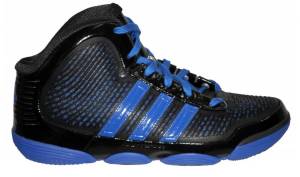
The adidas adiPure basketball shoe features an upper made of synthetic leather and SprintSkin monomesh that combine to decrease the weight of the shoe and increase breathability. The addition of PureMotion flexibility to the double last construction means you get the best of both worlds – flexibility and control.
When you first put the adidas adiPure basketball shoes on you will feel very low to the ground. Within just two or three runs the shoe will begin to flex more naturally. If support and protection are your top priorities for a basketball shoe you will find the adidas adiPure’s to be a good choice.
The adidas adiPure basketball shoes were created to fit anyone. Ideally, if you have wide feet you will get a better fit than most players. Featuring adiPRENE+ hidden in the double lasted midsole, you will find the adiPure’s provide you with excellent cushioning.
With excellent traction, the PureMotion configuration allows for your foot to find grip at much more extreme angles than your standard shoe.
All in all, the adiPure is a well rounded performer and a solid team shoe. If you have a hard time finding a shoe that is wide enough, the adidas adiPure basketball shoes are definitely worth a look. These basketball shoes are suitable for those who primarily play forward or centre.
The adidas adiPure basketball shoes are available at Sportsmart. You can view the adidas adiPure basketball shoes online or visit one of our stores to try out the shoes for yourself.
TEAM BASKETBALL TRAINING
Basketball is a challenging sport that requires speed, endurance, agility and strength. Players need to be able to accelerate quickly, stop and start with ease and run up and down the court without getting tired. Players also need to have upper body strength for dribbling, passing and shooting. Basketball team training should focus on all these things in order to help players improve their overall game.
Overall body strength training is key to building a strong player. Weight lifting, push ups, pull ups and resistance training all help build strength. Every training session should also involve sprinting to build speed. Coaches should time players sprinting from one end of the court to the other. By recording sprinting times at the beginning and at the end of the season, players can track their improvement.
Dribbling the ball between your legs without watching the ball can help players develop coordination. Players should practice dribbling with both hands while walking and running and trying to focus on using the hand they are most uncomfortable using.
There are many drills designed to help players develop defensive skills. Defensive skills involve learning a good stance, that is knees bent, eyes on the mid section of the offensive player and arms straight up. Coaches should also take the time to teach their team about rebounding. Drills such as taking shots and challenging players to retrieve the ball are useful.
Finally, players and coaches should focus on offense. Offensive skills include dribbling, passing and shooting. All of these skills can be developed during practice games. A useful drill is to get players to compete while taking free throws and three pointers. Play games such as knockout.
HOW TO PLAY DEFENCE IN BASKETBALL
Many, if not all coaches will say that a great defence is the key to winning a game due primarily to the fact that it prevents the other team from scoring. Basketball defence isn’t just about being fast and having good skills, it takes a lot of effort to study your opponent. At any level of play, from junior to senior defence must be a top priority.
Studying your opponent is not an easy task. You must watch your opponent and understand the type of game they play, the moves they make and the way they approach the ball. If you can get an idea of the way your opponent plays, you will be able to outsmart them. Some key questions to ask yourself when studying your opponent include:
- What are your opponent’s favourite shots?
- Is your opponent right handed or left handed?
- Does your opponent cut to the basket a lot?
- Will your team need to double team your opponent?
Your defensive stance is essential to a great defence. A good defensive stance allows your body to be ready to react in any direction. You should keep your knees bent and your feet shoulder width apart from each other. One foot should be a bit ahead of the other.
Don’t try to reach in and steal the ball if you have not yet perfected your defence. You are at risk of fouling your opponent, also you can fall for a ball fake which will put you off balance and force your teammates to cover your player. You can slightly raise your arms in a position where you can easily steal the ball if your opponent fumbles.
One of the smartest ways to out play your opponent is to force them to dribble with their weak hand. For example, if your opponent is right handed, put your left foot forward and close in aggressively so that you can pressure them to change hands quickly or direction.
Deciding on the amount of space to leave your opponent is important and something many players do incorrectly. Space depends on the situation. For example, if your opponent is a skilful dribbler, give them a full step or two so that it is harder for them to go around you. If your opponent is a good shot from outside the key you must play up close and force them to get rid of the ball rather than shoot.
HOW TO MAKE THE PERFECT LAY UP IN BASKETBALL
Mastering your layups will help you improve your game. Every player should master this skill before they attempt other skills such as a jump shot or technical moves. Many youths have trouble with layups and opportunities are often missed. A layup can be the difference between winning and losing. This article will describe a layup from a right handed perspective, if you are left handed simply reverse the left and right to do a left handed layup.
Stand about a meter or so to the right of the free line. This should make a 45 degree angle to the basket. Have a basketball ready and dribble towards the basket on the 45 degree angle. When you are getting close to the ring, secure the ball with both hands while still in motion to the basket. You should be picking up the ball just when your right foot is hitting the floor. Keep the ball on the right side of your body as you convert from dribbling to shooting the layup.
As you step with your left foot, you will want to plant it to jump towards the basket. When jumping off your left foot, your right knee should thrust upwards, this will allow you to explode up to the basket. Keep the ball in both hands on the right side of your body and extend your arms towards the basket.
Remember to focus your eyes on the target during the layup, avoid looking down at the ball. An ideal target is the upright line on the square of the backboard. As you reach the height of your jump, release the left hand and propel your right wrist foward to release the ball to the target. Let the momentum carry you past the basket. If you stop in front of the basket, you did not explode enough to the basket.
BASKETBALL PLAYS: FAST BREAK
A fast break in basketball is where the ball is pushed up the court before the defence has a chance to set up. It is probably one of the most exciting plays to watch and be a part of during the game. The objective of the fast break is to attempt to get an easy basket by using speed and accurate passing.
Most fast breaks occur because the team running the break finds themselves in a situation where they have more players running than the defence has to cover them. Fast breaks can occur due to a defensive rebound or an out of court play or even if a defensive player steals the ball. However, a fast break doesn’t just happen, not making the right decision in terms of who to throw the ball to can stop the play before it even begins.
Generally the guard should always get the ball on the fast break. Once the guard gets the ball they need to make their way to the middle of the court. This is because it will force the defence to decide on whether they will be going left or right with the ball. If the ball is on either side of the court the defence will know where the ball is going, but if the ball is in the middle of the court they have to cover the whole court which will generally lead to an easy attempt at a shot.
The player with the ball must decide what they want to do by the time they reach the foul line. That is, pass the ball off, drive to the ring or stop and take a shot. It is important to have supporting players following the person taking the fast break. If the offensive player finds themself in trouble they can quickly pass the ball and that player can take the shot under less pressure.
SHOOTING FOUL SHOTS
Shooting foul shots or free throws is a unique skill and is hard to master. Many players have problems perfecting their foul shot and would prefer to shoot from any other spot inside or outside of the key rather than take a shot at the free throw line. The technique of the foul shot itself combined with the pressure of making the shot is enough to cause you to make a mistake.
If you prepare yourself mentally, foul shots will be an easy shot for you to make. There is no defensive player in front of you to counter the shot; the shot is effectively the same over and over again. Good free throw shooters do the same thing every time they shoot.
Perfecting your foul shot will make a huge difference to your game. A lot of players come straight from a game and say ‘we could have won if only we made our foul shots’. Foul shots make all the difference and it is important to master this skill.
A few things to remember when taking a foul shot are to balance yourself at the free throw line, keep your feet shoulder width apart and parallel to one another. You must also point both feet and and square your upper body toward the basket. Position your feet just behind the line. If you tend to jump while taking the shot step one foot behind the line so that you do not jump over when you take the shot and the shot is considered a violation.
You must hold the ball using your non shooting arm to cradle and support it lightly. Place your middle three fingers on the seams of the ball and use your thumb and palm for support. Keep your shooting arm straight and the elbow of your other arm in.
Aim the shot, try to aim for the backboard box above the rim. If you hit the centre of that box properly the ball will hit and fall through the net perfectly. It is important that you remember to bend your knees. The strength from your legs will propel the shot.
Shoot in one motion and remember to follow through with your shot. Remember, a foul shot can be the shot that determines whether your team wins or looses.
 blog.sportsmart.com.au