HOW TO CHOOSE A DOUBLES PARTNER IN TENNIS

Playing doubles tennis is quite demanding, it is important to play with someone who fits your playing style in order to increase your odds of creating a winning doubles team.

Tip 1: Be certain when committing

Don’t commit to a doubles partnership unless you are certain the combination is the best fit for both of you.

Tip 2: Study and emulate the pros

Professional doubles players will always follow these key elements:

–          Constant communication

–          Support each other: willingness to forgive quickly for your mistakes and your partners

–          Adjusting positions, especially on serve and return of serve

–          Recognising the strengths and weaknesses of each player

Tip 3: Choose complimentary styles of play

Create a team where the players compliment, not compete against each other. For example, if one player is a big server, choose a partner who is a big returner or an aggressive volleyer. Keep in mind that great singles players do not always make great doubles players.

Tip 4: Consider personality traits when creating a doubles team

A team can have all the talent in the world, but if they are not playing together as a team and supporting each other, success will be limited.

Tip 5: Constantly seek self-improvement

Some doubles players have a tendency to become dependent on their partners to come to their rescue. This is dangerous as you will stop wanting to work on your weaknesses. Each player must constantly be working on improving their game, locate your weaknesses both individually and as a team and formulate strategies to improve.
HOW TO PITCH FASTER IN SOFTBALL

A good softball pitch has three basic stages that you must master in order to throw the ball accurately and effectively. The three main elements of a fast softball pitch are how fast the pitcher drives off the rubber; reaching back after the down swing and pushing back on the stride leg. Keep in mind that while you can practice your pitching as much as you want, the best way to improve your technique is to get help from a coach.

Start by springing off your push off leg. While a long stride is also important, speed as you push off is necessary too. Reach back with your pitching arm, creating a large circle. When you get halfway around the circle, tilt just the upper part of your body backwards a bit. While you do this, reach back towards second base. This will allow your arm to whip around better giving you more energy to release the pitch.

Stand tall as you pitch the ball. You’ll want your stride leg solid, your upper body erect and your overall body strong. Experiment with variations on a basic softball pitching stance. Try to start your pitch while bending, crouching or standing straight up. Vary how far back you swing your arm and how much you pivot off your back foot. Ultimately, you want to find the combination of mechanics that will work best for you and make your pitch faster.

Concentrate on your body while you are pitching. Try to practice at least every week to master the technique that works for you. Don’t try to find a new technique instead focus on the one that seems to be working best for you.

10 TIPS TO EXERCISE SAFELY

If you want to stay healthy and avoid injury it is important to exercise safely. Here are some tips to help you stay safe and injury-free:

Stop if it hurts: Stop the activity immediately and seek medical advice if you feel discomfort or pain, become extremely breathless or develop an irregular heartbeat.

Warm up and cool down: Try slow stretches and go through the motions of your sport or activity before starting. Cool down with slow stretching.

Pace yourself: Training too hard or too fast can cause injury. Have at least one recovery day each week to rest. Working through any pain will cause more damage.

Mix it up: Try other sports and exercises to reduce the risk of overtraining.

Strap or tape: If a joint is prone to injury, consider strapping or taping it before exercising. Even better, see an exercise physiologist to obtain a program to strengthen the injured area and get advice on proper taping technique.

Stay hydrated: You can lose around one and a half litres of fluid of every hour of exercise, so drink water before, during and after a session.

Be weather aware: Take it easier in hot weather and wear clothing and sunscreen to protect you from the elements.

Do it right: Get the technique right, as improper form or technique can cause injury.

Check the gear: Make sure your shoes and equipment fit properly and are right for the activity. Look after your equipment and check it regularly for safety.

Be sensible: Especially at night or in secluded areas. Take a friend with you and stick to well lit areas and wear bright or light reflective clothing so drivers can see you.

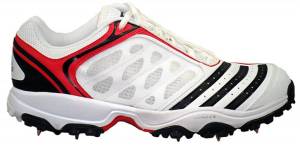
REVIEW – ADIDAS TWENTY2YDS LITE IV CRICKET SHOES

The Adidas Twenty2yds IV cricket shoes are both lightweight and stable while also being low to the ground to make for a truly versatile shoe. Tooling of the shoe has been specifically designed to be extra stable, with a low foot bed and wider midfoot. This allows you to achieve a solid foot plant position when facing deliveries.

The rubber traxion outsole adds to the grip while the adiPrene inserts in the heel and adiPrene+ in the forefoot offer great impact cushioning and durability. The 3D torsion in the midsole adds to the support of the shoe in the foot strike.

The redesigned Climacool mesh upper has been developed specifically to allow your feet to breathe while also providing protection against dust.

The Adidas Twenty2yds IV cricket shoes are now available at Sportsmart. You can view the Adidas Twenty2yds IV cricket shoes on our website or visit our stores to try a pair on for yourself.

BASKETBALL DRIBBLING DRILLS TO IMRPOVE YOUR GAME

Basketball requires players to not only effectively move their feet, but also to manoeuvre a basketball. Basketball players first learn to dribble the basketball with one hand, then to alternate hands and progressively to increase to more advanced dribbling. As a basketball player, a powerful and effective way to keep defenders on their toes and increase your threat as an offensive player is to develop a quick dribbling technique.

When dribbling use your fingertips not the palms of your hands. Basketball is played on the tips of your fingers and the balls of your feet. Use your forearm and wrist to bounce the ball. Don’t look at the ball always look up.

The following drills will help you improve your ball handling and dribbling skills.

  • Scissor dribble: Stand in the triple threat position (feet roughly shoulder width apart, one foot ahead of the other, knees bent) and dribble the ball with your right hand, sending it between your legs and to the left side of your body. Move the ball to the front and with your left hand, make a hard dribble through your legs and to the right (rear) side of your body. Continue until you develop a good rhythm and speed the dribble up as you get better. Do the drill for a full minute, resting 30 seconds, then repeat.
  • Full court zig zags: Stand on the baseline just under the right side of the backboard and dribble to the right sideline at a 45 degree angle with your right hand. Stay low, keep your head and eyes up so you can see in front of you. When you get to the sideline, change direction with a cross over dribble and dribble with your left hand at a 45 degree angle to the centre of the court. Repeat this drill the full length of the court. Once you reach the other end of the floor, turn around and do the same drill back.
  • Full court speed dribble: Standing on the baseline, dribble at full speed up the court. Stay under control but push the ball up the floor as quickly as possible while still maintaining complete control of the dribble. When you reach the opposite free throw line, come to a strong and on balance two foot jump stop. Repeat the drill five times, each time stopping at the free throw line with a two jump stop.
  • 2 ball dribbles: Two ball drills are some of the best possible drills for improving ball handling skills. Start by dribbling both balls from the baseline up to the free throw line, with both basketballs hitting the ground at the same time. Once you reach the free throw line, start a stagger dribble where each ball hits the ground separately. Use this stagger dribble to the half court line, then switch back to a simultaneous dribble to the free throw line, then a stagger dribble to the baseline. Do this for two full court lengths. Next, do an up and back drill where you take 4 or 5 steps forward dribbling both balls, then take 2 or 3 steps back, continuing the full length of the court.
  • Wall dribble: The wall dribble drill is a great way to improve your finger, wrist and arm strength. Standing next to the gym wall, dribble the basketball at shoulder height against the wall. Dribble the ball a half inch or inch from the wall, really pounding the ball hard against the wall, moving it up and down and left to right. Do this for 20-30 seconds at a time with one hand, then switching to the other hand. Rest for a minute and then repeat with the right and left hand.

TACKLING IN SOCCER

When you are defending during the game never charge at the ball unless you are absolutely sure that you will get it. If the opposition has the ball in control at their feet, then you must contain them. To contain (or jockey) your opponent means to position yourself in front of him and wait until he releases the ball far enough for you to intercept it. Some dribblers will move the ball without providing you with enough time for a tackle. In these cases all you can do is remain between the ball carrier and your own goal.

There are different types of methods you can use when you are defending in soccer:

–          Containing: When containing an attacker you must lower your centre of gravity by bending your knees and leaning forward. Backpedal if the attacker moves sideways. It is important to never face a dribbler straight on because they will put the ball between your legs or may simply run by you and in this case you won’t have enough time to make a complete 180 degree turn. Try to approach the ball carrier at a 45 degree angle which will then force him towards the sideline. Do not lunge at your opponent.

–          The block tackle: The block tackle is the most basic way of depleting an opponent of the ball. It is designed to give you possession while keeping you on your feet. Plant your supporting foot firmly so that you don’t lose balance. Then just as your opponent contacts the ball, you must put your free foot perpendicularly to the direction in which he is moving. If you execute this properly, this will cause your opponent to stumble.

–          Poke tackle: With poke tackling, you basically stab the ball away from your opponent. You must use the foot which is closer to the ball. Remember, this method does not guarantee that you will gain possession of the ball.

–          Side tackle: The side tackle should not be used unless in desperation or when you are away from your own goal. It is very effective against opponents dribbling down the sideline or shielding the ball.

HOW TO PLAY CENTRE IN BASKETBALL

The centre of a basketball team is responsible for making close up baskets on offense and stopping shots on defence. Read the following for some tips to help you play your best at centre.

The basic shots that a centre needs to work on are:

  • Short jump shots from underneath the basket.
  • Powerful layups. A layup requires jumping high near the basket and rolling the ball with off with your fingertips so that it touches the backboard and falls into the basket.
  • Faking a shot by moving your body as if you were taking a shot to cause the defender to move and then take the shot.

Offense as a centre is also important. The centre must run down the floor quickly to get in position for a quick layup if you are open. Stay near the basket if your team has the ball. Move in and out of the key quickly to get open for the basketball and a shot.

Always look for the open man to pas the ball to if you are under pressure and don’t have a good open shot at the basket. Box out by placing your body between the basket and the defender when a teammate takes a shot at the basket. Move fast and rebound any missed shots.

Defending properly is very important for the centre of the team. It is important to get to the key as soon as possible if the opposition has gained possession of the ball. Take up space by playing wide with your legs and arms spread out more than on offense.

Block shots as often as you can by positioning yourself between the shooter and the basket and extending your arms as high as possible. When your opponent jumps to take a shot, jump as high as you can and try to hit the ball with one hand.

Box out again when the opposing team shoots by putting yourself between the basket and the other team. Finally grab loose balls bouncing off the rim or backboard to take possession of the ball for your team. Keep a look out for any opportunities for fast breaks.

10 COMMON CRICKET TRAINING MISTAKES

  1. Not warming up – The warm up is not only about injury prevention. A good warm up improves your performance by mobilising your key muscles so they can be used both more quickly, powerfully and with better timing. A good 15-20 minute warm up is vital before every session or match if you want to get the best from your skills.
  2. Warming up badly – This is almost as bad as not warming up. A bad warm up can slow you down and cause injury. It is important that you warm up for long enough before you pick up a bat or ball and don’t do any static stretching.
  3. Playing without a goal – Going to the nets or a game without a goal is not a very effective approach. It is far better to know what you are aiming for. In tests, the people who did the best were those who set goals compared to those who just tried their best.
  4. Avoiding fitness – Good fitness training is both enjoyable and vital for your game.
  5. Being too specific – Cricket is a game of skill, but just practicing cricket skills will not improve your general sports skills such as speed, agility, power and mobility.
  6. Not being specific enough – It is vital to develop both cricket and general sports skills. It is counter productive to train in ways that are not related to cricket at all.
  7. Not drinking enough – Dehydration is a major cause of performance loss.
  8. Staying the same – Different times of the year call for different approaches to training. If you train the same all the time your body and mind will get used to training and you will stop improving.
  9. Doing too much – Make sure that you have a rest from training at least once a week.
  10. Giving up after failure – If you drop a catch in the slips you may tell yourself you are a bad slip fielder, if you are not getting results quickly in the gym you pack it in. Failure is an indicator that you are learning. Good players keep trying.

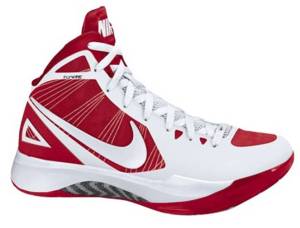
REVIEW – NIKE ZOOM HYPERDUNK 2011 BASKETBALL SHOES

The Nike Zoom Hyperdunk 2011 basketball shoes are ultra lightweight and a top performer on the court. Giving players a stable and supportive fit, these basketball shoes are made specifically for fast paced play on the court.

The Flywire nylon bundles at the midfoot allow for super strong, lightweight support for your feet. The Nike Zoom units in the heel and forefoot provide you with responsive cushioning while the ultra strong midfoot shank provides enhanced support and stability. Another great feature is the pivot point located on the outsole which provides players with stability while they are performing multidirectional movements on the court.

You will get all the support and stability you need with the Nike Zoom Hyperdynk 2011 basketball shoes. The combination of flywire bundles and breathable mesh lock your foot into place while the midsole is equipped with an ultra-lightweight, super strong glass reinforced shank that wraps up the sides of the foot and covers a wide area along the bottom for firm, yet flexible stability.

The Nike Zoom Hyperdunk 2011’s allow you to stay fast and grounded. Featuring a flexible, ground-gripping rubber outsole and flex grooves to help increase your natural range of motion.

The Nike Zoom Hyperdunk 2011 basketball shoes are currently available at Sportsmart. You can view the Nike Zoom Hyperdunk 2011 basketball shoes online. 


HOW TO PRACTICE TENNIS

Tennis players who want to move beyond their beginner level must devote time to refining their skills. The skills needed to volley a tough serve and send a backhand shot past your opponent does not come naturally. Your tennis skills will only improve with hours of practice and commitment to improvement.

Find a tennis court in your community where you can practice. Your primary court should have a well maintained playing surface, nets and small storage areas for personal belongings.

Stretch your back, legs and arms prior to hitting the tennis courts for practice. It is important to spend 10-15 minutes before and after practice keeping your muscles loose to avoid cramping.

Use the same tennis racquet for practice and live matches to maintain you form. Beginner tennis players should get comfortable with the handling of your racquet as they practice to focus on fundamentals during matches.

Wear comfortable clothing during tennis practice to avoid problems with posture and form. Tight shorts and shirts along with uncomfortable shoes draw your focus away from hitting the perfect volley back to your opponent.

Live up targets along the base line to practice your serves from both sides of the court. You should place orange cones at one foot intervals from side to side and aim for the cones as you strike the ball. Start to volley at the net with your practice partner and gradually move to the base line. Challenge your partner with forehand and backhand shots as you step back.

Aim your backhand shots at the point where the base line meets the side line to refine this skill. You can place a cone just inside the corners of the opposing court to give yourself a target.

Finally you can ask a friend to score games between you and your tennis partner to prepare for future matches.