
Category: FITNESS & RUNNING
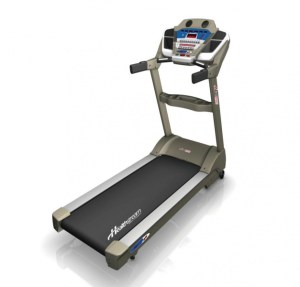
HOW TO USE A TREADMILL
Treadmills are the motorised equivalent of walking or running. You basically have to keep up with the movement that is happening beneath you. Treadmill workouts burn the same number of calories as walking or running outdoors. The only exception being running up hill. When you incline the treadmill, it is much easier than running up a hill.
Today’s treadmills are more springier than ever and have many features such as being able to connect to the internet and being able to store up to 100 training programs. When using a treadmill you must pay attention or you could stumble. In order to avoid this, start off slowly. Most treadmills have features that help you to prevent starting your workout at fast speeds, but its better not to take any chances. Always place one foot on either side of the belt as you are turning the machine on and step on the belt after you know it is moving at an appropriate speed.
Don’t rely on the handrails. Hold on for balance at the beginning when you are learning how to use the treadmill, but let go when you feel that you are comfortable and ready. It can be bad for your elbows and you are likely to burn fewer calories. However, if you have balance issues, use the handrails as lightly as possible to help you feel steady and secure.
You have to remember to look straight ahead. Focus on what is in front of you as your feet have a tendency of following your eyes. If you are focusing on what is in front of you will usually walk straight ahead. The first couple of times you use a treadmill, you might feel disoriented and dizzy. This is completely normal and the feeling will pass after a few times.
An important tip to remember is to never run on the treadmill barefoot. Always wear a good pair of walking or running shoes during your workout for support and also to prevent any injury. You must also try to minimise distractions i.e. reading while on the treadmill as you can risk loosing your balance and falling.
Sportsmart has a large range of treadmills available which you can look at online or try for yourself at any of our stores. Our expert staff can also help you to select and show you how to use a treadmill that is suited to your needs.
HOW TO USE AN ELLIPTICAL TRAINER
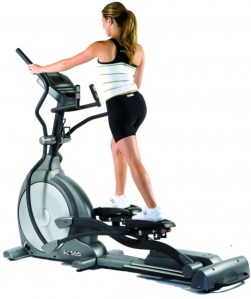
When using an elliptical trainer, your feet follow a path that is stretched out similar to an oval shape. This is known as an ellipse (hence the fact elliptical). Elliptical trainers can require a bit of getting used to but other than that there is no real skill needed to use them.
Ellipticals offer you the benefit of a low impact work out and to exercise your upper and lower body. Always start your workout with a warm up. Once you step on the machine, pedal forward. Limit your backwards pedalling as it does not work your body more than pedalling forwards. In fact, it can be damaging to your knees.
Use the machines features to adjust the intensity of your workout. Try pedalling faster or raising the incline. Challenge yourself every time you use the machine. Try not to lock your knees, keep a slight bend in your knees and the motion smooth. Also remember to stand up straight and keep your head up and level.
The elliptical has a pair of foot pedals for your feet, as you get on the exercise machine pay attention to where you are placing your feet. Each foot should be on the centre of each pedal and your stride should feel natural. A stride that is too long can feel uncomfortable and a stride that is too short can create an unpleasant and jerking movement.
Most elliptical trainers have a pair of handles to connect your arm movement to feet. As your feet move, so do your arms. You can choose to use the handle bars or to move your arms in a manner similar to walking or running without holding on. If you choose to hold on, be careful as leaning with your bodyweight on the handles will decrease the intensity of your lower body workout and will therefore slow your calorie burn.
When using the elliptical gradually work up the time you work out for. Start with a few minutes and then gradually work your way up to at least a 20 minute work out. It will take time for your muscles to get used to this new exercise.
Sportsmart stocks a wide variety of elliptical trainers. Visit the Sportsmart website to view our range. Or come in store to get expert advice from our fitness staff.
THE IMPORTANCE OF RUNNING SHOES
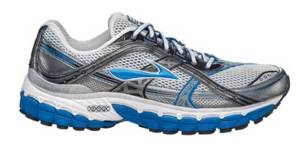
If you are a runner, it is very important to find running shoes that are suited to you. Your running shoes play a major role when running and are a way of protecting your feet as they hit the ground.
Different running shoes serve different purposes. For example, trail running shoes are designed for those who run off road. The first thing you need to decide on is the type of running you will be doing. You can then select a shoe based on your running requirements.
Wearing the wrong type of running shoes can cause major damage. The impact of running not only affects your feet but also your ankles, knees and hips. Everybody’s feet are different and a good pair of running shoes can save you from injuries and pain.
When purchasing a pair of running shoes, pronation must be considered. Pronation refers to how much your foot rotates inward while you run. Runners who have a foot which rolls inward are considered to be runners who overpronate whereas runners who have a foot which does not roll inward much are considered to be runners who underpronate. Both styles can present problems to runners therefore it is important to select a shoe that is suitable for you.
Sportsmart has a large range of running shoes available that you can check out online. Our footwear staff have expert knowledge in running shoes and can help you to select a style that suits your running needs. Visit us in store to get expert advice and try on the right running shoe for you.
PRODUCT REVIEW: YORK MONZA ELITE TREADMILL AT SPORTSMART
The York Monza Elite Treadmill is one of York’s finest treadmills. It features unique and exclusive technology and is packed full of features to keep you motivated. It is ideal for those with a big family or the serious runner. With its strong motor, large running deck and full featured console, this treadmill definitely earns its name.
With a 3.5 horse power motor, the York Monza Elite Treadmill has the ability to reach up to 22km per hour in speed. It also features a 3.3mm orthopaedic belt which is an important feature for those who require extra cushioning.
For those who require extra motivation, the York Monza Elite treadmill also has a USB port that allows you to watch videos or pictures on its full colour display. You also have the ability to plug in your iPod or iPhone and listen to. It even has 21 motivational programs of its own that you can select from and watch while running. If you have had a great session you have the ability to save your training results and upload them to your computer for future reference.
If you have difficulty balancing on the treadmill, the York Monza Elite has a built in camera that allows you to view your feet while you run so that you can stay on track. Another useful feature is the proximity sensor. The proximity sensor is also if you have pets or young children and will alert you if they get too close to the back of the treadmill.
The York Monza Elite treadmill is packed full of features that will keep you going during your workout and definitely differentiate it compared to other models currently available.
Sportsmart currently stocks the York Monza Elite treadmill, view this product on our website http://www.sportsmart.com.au/product.php?pid=13657&refid=132&refname=Treadmills&pg=2.
Or come in store to try it out for yourself.

THE KETTLEBELL 101: DEADLIFTS AS FOUNDATION
Jeremy ‘Dave’ Davies is the Store Manager at Sportsmart Kilsyth, but he has also been an infantry soldier, boxing instructor, personal trainer and Australian Kettlebell Instructor. Apart from basketball, he competes in Girevoy Sport Weightlifting – the traditional Eastern European/Russian sport of kettlebell lifting. You can visit his website www.wix.com/kgbtrainer/kgbpt for more information and training tips. He has taken the time to provide some information and training tips on strength bags.
With Sportsmart’s catalogue special on York kettlebells this month, I thought it would be a great opportunity to introduce this strength training tools fantastic benefits, and some of its pitfalls too…
You’ve all probably seen them, maybe on The Biggest Loser, maybe in the park with a personal trainer nearby. Maybe you’ve even played around with them a little in the gym.
I’ve been using them for over five years now, firstly as a health and fitness enthusiast, then as a personal trainer and group fitness instructor, and more recently, as a girevik (kettlebell sport participant)
From my experience I can honestly say that there is no better individual health and fitness tool that can do as much for you in as little time as the kettlebell. You can develop lean functional strength, tone your posterior chain (lower back, butt, thighs) and core, develop power (maximum strength in minimum time), strip fat, increase cardio fitness and better your posture, amongst many other benefits.
But you have to do it right.
So, what’s right?
Firstly: back posture. My clients would get sick of hearing me bang on about it, but this is crucial. For the same reasons that kettlebells are so good, if done with poor posture, they can be very bad.
The York kettlebell comes with a very good instructional poster detailing a whole range of fantastic exercises, but don’t go straight to a single arm snatch or swing or Turkish get up. Instead, start with a basic deadlift.
Plce the kettlebell between your heels. Before you even start lowering yourself down to pick up the kettlebell, tilt your pelvis top forward, bottom back. The more flexible your hips are the better, and this is where women often have an advantage over men starting out.
Now, push your butt back before you start bending at the knees.
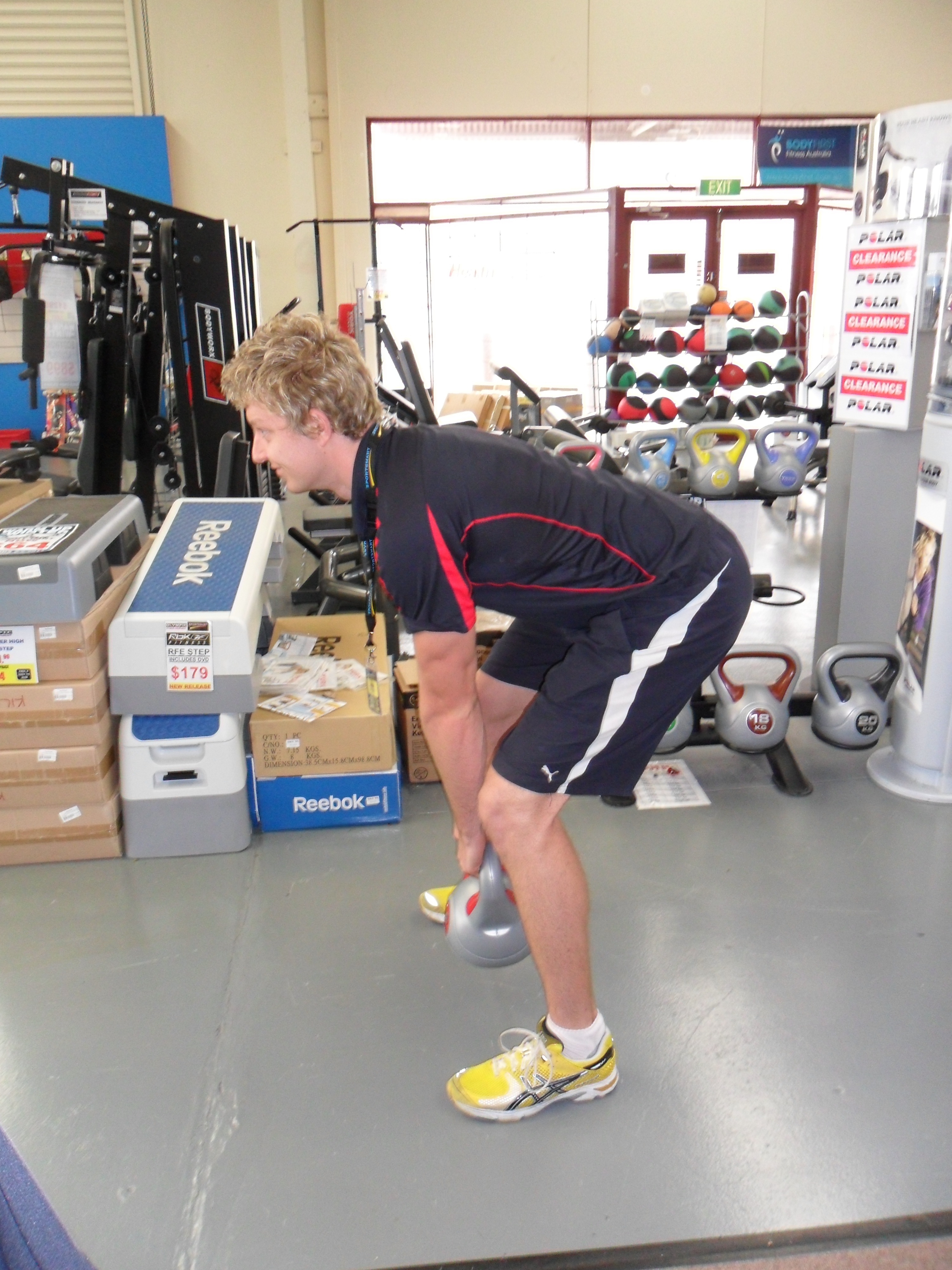
Keep that pelvic tilt! And keep your eyes up at horizon level: you don’t need to look down. That kettlebell is going nowhere without you. Maintain a good neutral spine alignment as you push back, like the old ‘sit up straight’ position, then start bending at the knees. Keep those eyes up!
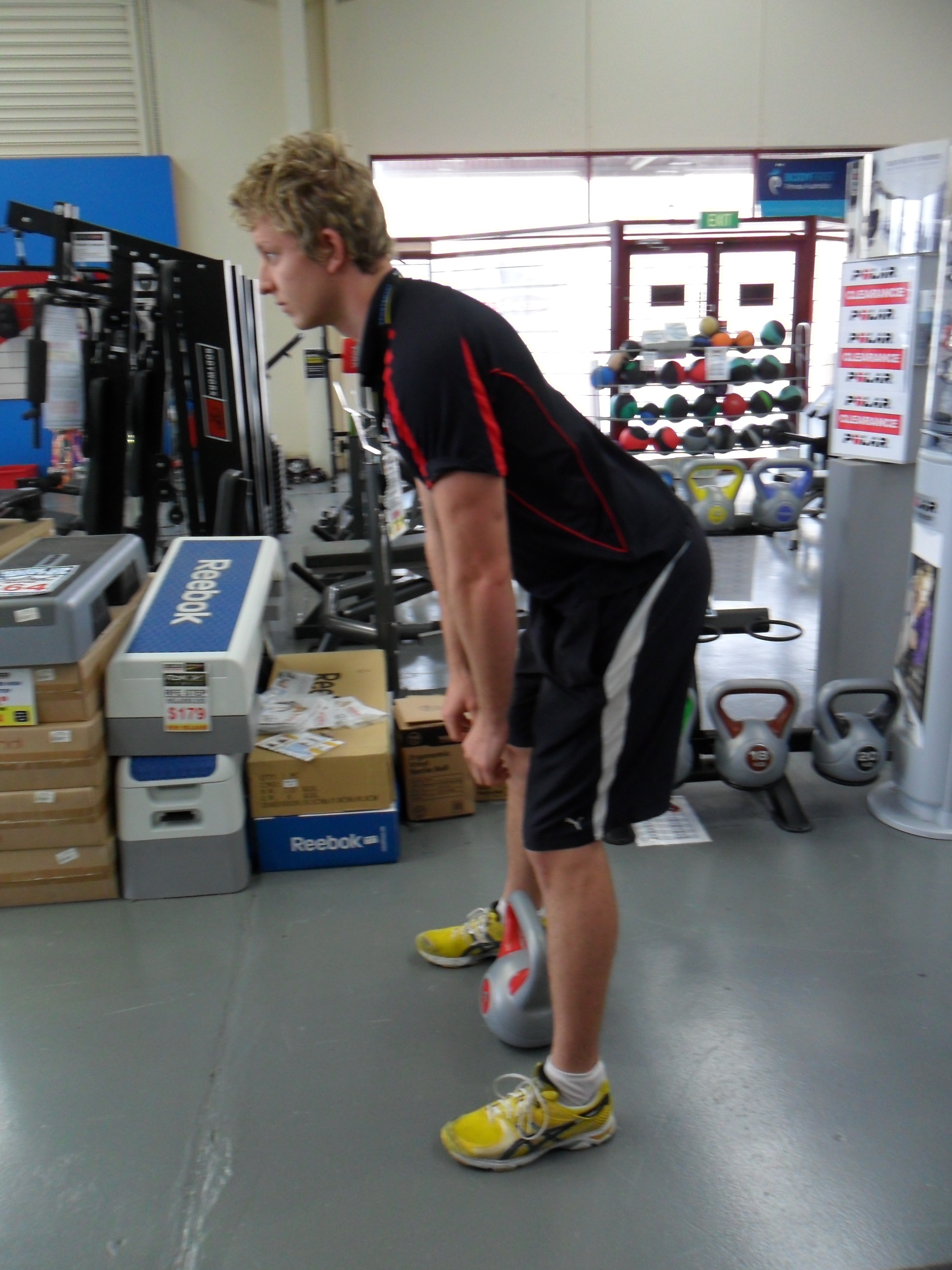
And pick up the kettlebell with two hands.
Stand up straight, roll your shoulders back gently at the top, and repeat, letting the kettlebell gently kiss the ground between your heels without bearing any weight.
Getting this movement right is critical to safe kettlebell lifting in the future, particularly with the most beneficial compound ballistic lifts, such as the swing, the clean, the snatch and the high pull.
Make it a part of a circuit with other more traditional activities that you are comfortable with, such as skipping or dumbbell/barbell lifts, or burpees etc, before you go further with the kettlebell.
Once it feels comfortable, add an upright row movement to the deadlift. As you stand up, row the kettlebell upward until your forearms are parallel to the ground. But don’t just hold the kettlebell up there like you would if you were doing upright rows with a barbell or dumbells, drop immediately with the weight of the kettlebell.
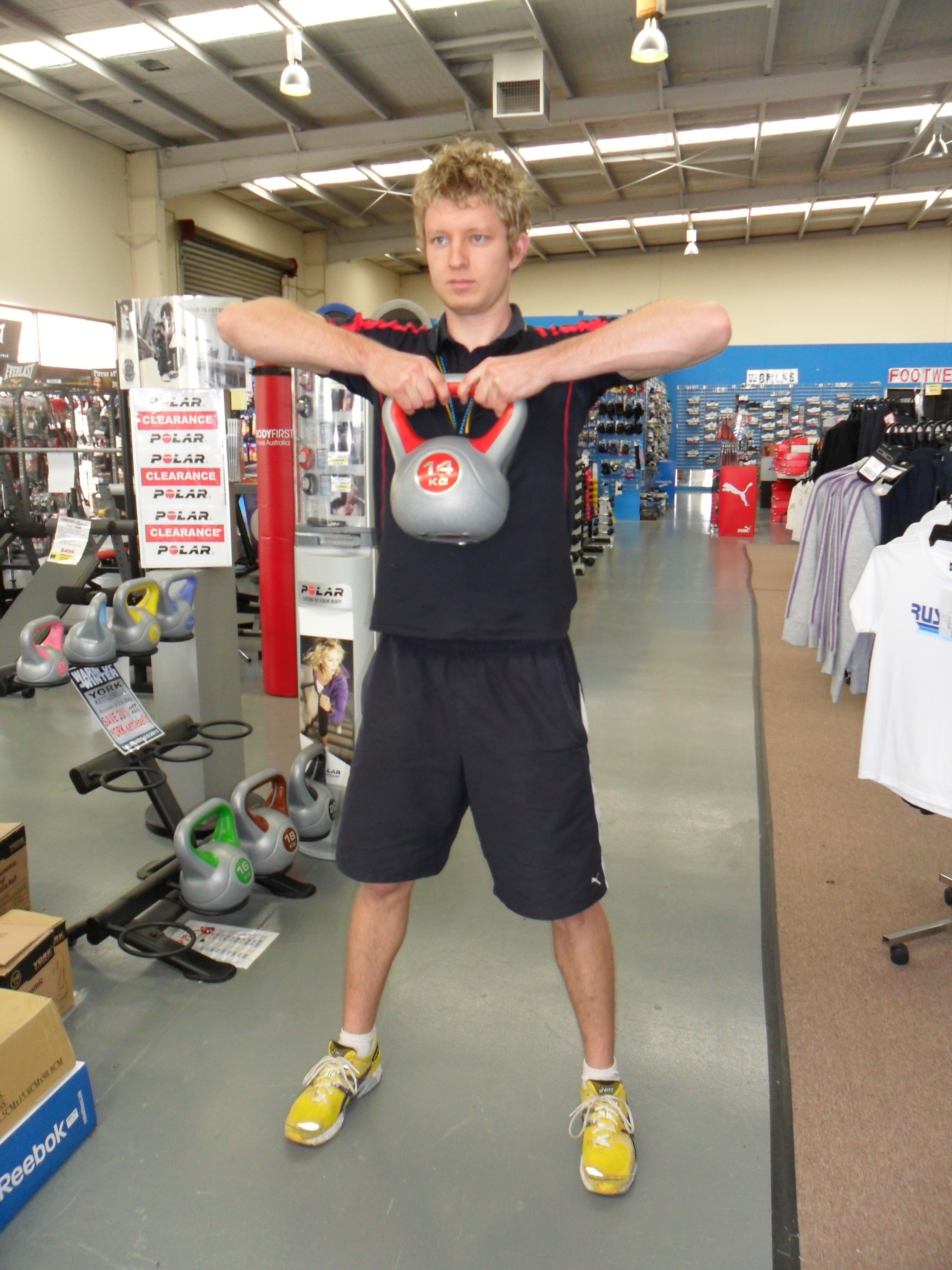
It shouldn’t be an isolative shoulder exercise. The weight of the kettlebell should be primarily shifted by the motion of you standing up straight from the bottom of the deadlift position.
Any further questions regarding kettlebell training, why not drop in for a chat with me at Sportsmart Kilsyth!
STRENGTH BAGS: FOR MORE THAN JUST STRENGTH…
Jeremy ‘Dave’ Davies is the Store Manager at Sportsmart Kilsyth, but he has also been an infantry soldier, boxing instructor, personal trainer and Australian Kettlebell Instructor. Apart from basketball, he competes in Girevoy Sport Weightlifting – the traditional Eastern European/Russian sport of kettlebell lifting. He has taken the time to provide some information and training tips on strength bags.
If you’re looking around for something a bit different to really get your heart pounding and muscles working, the Bodyfirst Strength Bag is worth a look.
What you get is a well-secured rolled up tube of sand with handles in a range of weights, from 5kg up to 35kg.
It’s simple, but effective. New-school technology and adaptation, with additional handles and strong PVC casing meets old-school hard yakka.
The weight is unstable; forcing your core to adapt to it while in motion, but the bag is soft so you can’t knock yourself out.
With kettle bell-style lifts, like the snatch and the high-pull and the swing, you can really work on power (maximum strength over minimum time) while smashing calories.
With more static lifts, such as a press or squat, you can build lean strength and tone, just like with dumbbells or barbells.
Adding the resistance of the bag to abdominal lifts will increase the burn on your core, as with medicine ball Russian Twists.
You can throw it on a shoulder and run, fall down on it and push up: all that kind of crazy, old-school sandbag-style training.
It’s great for outdoor circuit work, in a backyard or your favourite park. Depending on your starting strength, if you pick up a ten or a twenty kilo bag from Sportsmart, you can try this on for size:
At 30s on and 15s rest.
- Snatches
- Front Squats
- Fence Hops
- Overhead presses
- Weighted sit-ups
- High-pulls
- Pushups
- Leg Raises
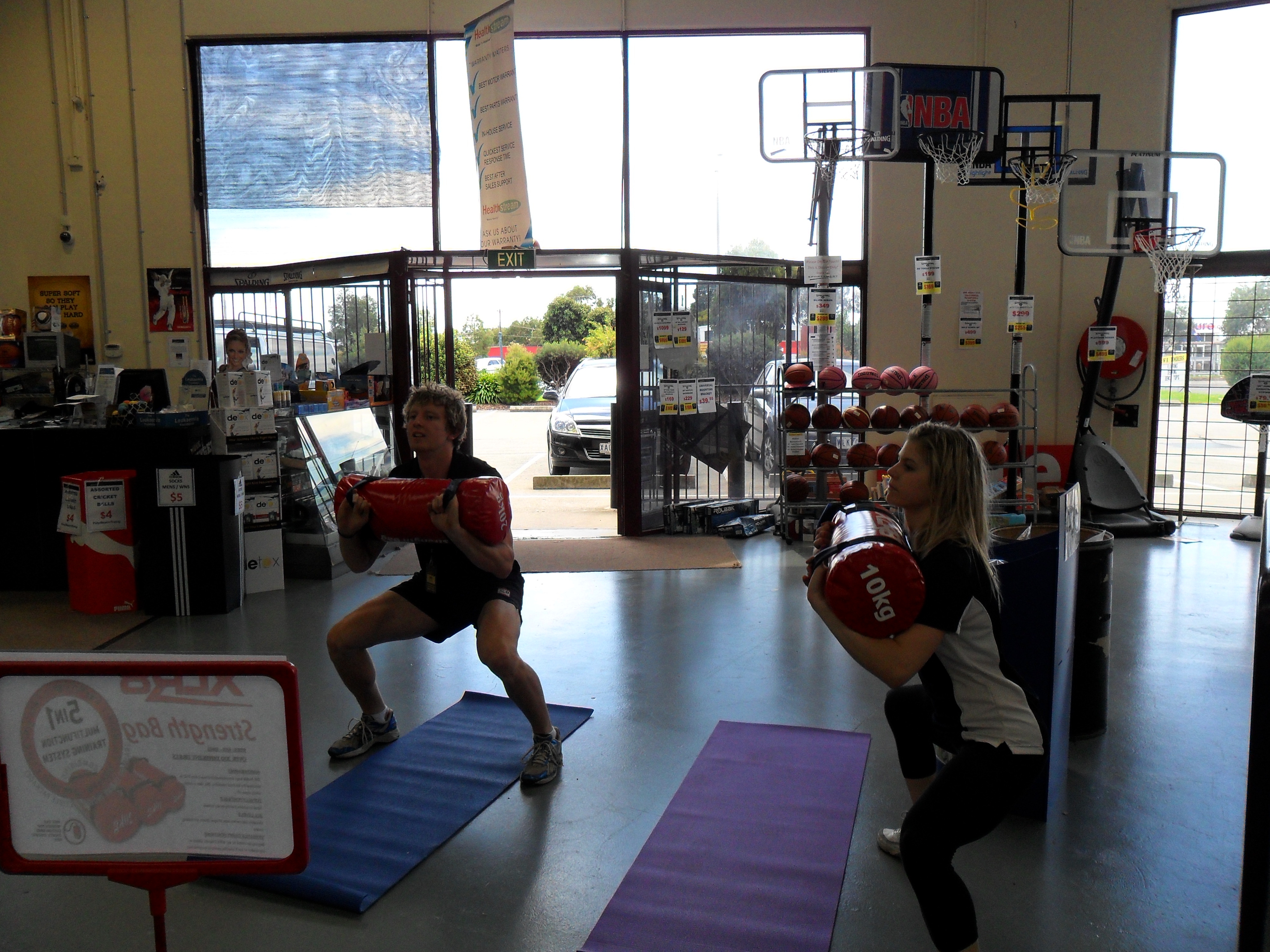
Ben and Jody, two super-fit retail assistants at Sportsmart Kilsyth, went through this quick 4 minute + rests workout and loved it. ‘You could really smash yourself with this,’ Ben said, through deep breaths.
As your cardio fitness and strength improve, you can increase the amount of time on, or upgrade to a heavier bag!
If you have the dosh, two bags can give you even greater flexibility: either two of the same weight for double armed exercises, or a heavier and a lighter weight for different levels of resistance.
As always, it’s best to consult a medical professional before embarking on a new workout regime. And if you’ve got any questions, or want some more advice on exercising with Strength Bags, drop into Sportsmart Kilsyth for a chat.
…and enjoy the pain!
NIKE RUNNING CLOTHING
Sportsmart Clothing Manager, Liam Collins
Need running gear? Check out some of the great specials we have on top-quality Nike running clothing…
MEN
2-inch running split-leg short with built-in fabric liner and side vents. Internal key pocket – $39
4-inch running woven short with elastic waist and internal drawcord. Internal key pocket – $39 (pictured)
Running singlet (e-singlet), made from recycled polyester and comes with a shaped hem and flat lock side seams – $39 (pictured)
WOMEN
Dedication long vent racer back tank, comes with interior support bra and zoned ventilation – $49 (pictured)
Tech capri, comes with bonded side seams which provides zero distraction by eliminating seams that can cause chaffing. A secure storage pocket tops off this number one seller! – $69 (pictured)
*Prices are all Christmas catalogue prices, valid until 25/12/2010.

FITNESS & RUNNING TRAINING TIP: SAND RUNNING
Personal trainer, Tavia Ambler
Sand running is a great workout for the cardiovascular system. It also aids in the development of balance and strong core muscles.
Sand is uneven, so it is important to concentrate on the stability of ankles, knees, hips and the lower back. This is achieved by contracting your abs, which supports the lower back and strengthens the core. Sand running also puts more pressure on the calf muscles (sore muscles after a session is normal).
Athletes should not just do sand running alone, but incorporate it into their fitness regime once or twice a week. The below workout incorporates sand running with resistance training (which can also be done on the sand/beach), making a great routine for both running fitness and general body fitness.
Workout
- Set up a shuttle run course by placing 4 cones 20 metres apart in a straight line.
- Warm up by jogging to the first cone and back, second cone and back, and third cone and back.
- Increase speed so that you sprint on the way to the cone and jog back. When the body is warmed up, increase the speed and sprint the whole way (to and from each cone).
- Set up a circuit on the sand, or otherwise on a nearby path. Complete 1 minute on each station: push-ups, squats, dips, lunges, step-ups and crunches.
- Back to the shuttle run: repeat steps 2 and 3.
- Back to the circuit: repeat step 4.
- Cool down with a walk, followed by a 10-15 minute stretch.
HEART RATE AND EXERCISE
How to monitor your heart rate, and how that information can be used as a key indicator towards reaching training goals, can be misunderstood by the average trainer.
As I have discussed in previous columns, being specific in goal-setting is vital to the success of obtaining the desired outcome. Monitoring heart rate can be of enormous benefit, as it allows the trainer to understand how their body is reacting to a particular exercise intensity, and whether or not that activity corresponds to their training goals.
Let me explain: typically a trainer’s goal/s will range from weight loss to a gain in fitness or endurance, or an improvement in performance. But how do you know what intensity to exercise at in order to reach that goal?
Using a heart rate monitor as a training tool enables the trainer to use a percentage of their maximum heart rate as a guide so that the intensity chosen is best suited for that goal. If the intensity is low (50-60% of maximum heart rate), and the duration is long, then fat will be your body’s preferred energy source and weight loss the ultimate outcome. If the intensity is high (80-90% of maximum heart rate), and the duration short, then carbohydrates will be the preferred fuel and performance will be the end outcome – and there is a whole spectrum in between.
Heart rate monitors are a relatively inexpensive way to ensure that a trainer is not choosing activities in a random fashion, and that all energies can be put toward their chosen goals.
Sportsmart Kilsyth Footwear Manager, Adam Musovic
FARTLEK TRAINING
Most people have a tendency to fall into a comfort zone when it comes to running. Yes, you may run for 30-45 minutes without stopping, but are you getting any faster?
If you are a long-time runner, or even a beginner, and want to increase your speed or add a bit of variety to your training, then fartlek training is for you.
So, how does it work?
Fartlek running training requires you to work at a higher intensity over a given period of time. It normally requires you to perform at high intensity followed by a recovery period.
For example, if you normally run continuously for 30 minutes, changing it to a fartlek session could look like this:
5-minute warm-up jog
3 x 3-minute fast runs
5-minute cool-down jog
Your fartlek session should generally take less time because it is higher in intensity.
You don’t need to do this type of training every session; if you run three times a week, add in one of these sessions each week. Your weekly running program should actually include one long moderate-intensity run and one shorter high-intensity run.
If your goal is running under a certain time for an upcoming event, start adding some fartlek and interval training into your running. If your running isn’t performance-based and you don’t keep time, this type of training will help you burn extra calories due to the higher intensity.
Exercise physiologist & adventure tour guide, Marc Stafford
(www.marcstafford.com.au)
 blog.sportsmart.com.au