
Category: TENNIS
HOW TO: IMPROVE YOUR SERVE
The most difficult shot to master in the game of tennis is the serve. Here are some basic tips to help improve your serve and assist in making this shot a more attacking weapon.
1. Change your grip
2. Put more spin on your serve
3. Direct the serve to your advantage
4. Increase the speed of your serve
1. Change your grip. Most beginners use a forehand grip on the racquet when learning to serve. This grip assists beginners to hit more serves into the service box with fewer mistakes. More advanced players should change to the more advanced continental grip. You should start slowly by hitting only at around 25% speed, as this new grip will feel slightly uncomfortable. Gradually increase the speed of the serve as you become more competent.
2. Put more spin on your serve. Once you become more comfortable with the new continental grip, experimenting with the ball toss is vital to imparting more spin on the ball, either with slice or top spin. Throwing the ball slightly behind your head and arching your back to strike the ball should assist in putting some top spin on your serve.
3. Direct the serve to your advantage. As you become more competent with your new service action, the next step is to focus on the way you direct the ball into your opponent’s service box. Whether serving it to the forehand or backhand side of the court, a cleverly directed serve can apply more pressure on your opponent’s return of serve.
Eg. Hitting a slice serve out wide to the forehand side of the court or hitting a top spin serve wide on the backhand side of the court will open up the court for your next shot in the rally.
4. Increase the speed of your serve. Once you get comfortable hitting more balls into the correct positions in the service box, you can begin to increase the speed of your serve. Throwing the racquet head at the ball with more force and following through past your left leg will naturally increase the speed of your serve.
*Remember: the serve is the only stroke that you can control from the outset of the point. Every other shot you play depends on where and how your opponent hits the ball. Therefore, take as much time as possible to organise your stance, grip the racquet with the continental grip and position the ball toss in exactly the right position for where you want to hit the ball.
I hope these tips improve your serve and assist your enjoyment of this great game.
Sportsmart Tennis Manager and TCAV tennis coach, Ray James
CHOOSING TENNIS SHOES
Sportsmart Footwear Manager, Ryan Meggs
Q. Why is it important to choose the correct tennis shoe?
Tennis can be very demanding on the body due to the twisting, running, jumping, and the stop-start movement that goes on during a game. This is why it’s really important to select the correct pair of tennis shoes to help avoid injury and to provide the right amount of cushioning, stability and support.
Q. What are the key features to look for?
The majority of tennis shoes will have a leather or synthetic upper for foot support. Tennis shoes also need to absorb a high level of shock and impact, so rear and for foot cushioning is must. Probably one of the most important features in a tennis shoe is strong mid-foot torsion or mid-foot stability. Strong mid-foot support helps to stabilise the foot as it goes through its many motions during a game of tennis. Most good quality tennis shoes will also have a reinforced toe piece, as a lot of tennis players drag their toes while serving.
Q. What are the latest popular styles?
One of the most famous tennis shoes is the Adidas Barricade, which provides everything a tennis player would want from their shoes. This model has been around for many years and is extremely popular right across the world. Some of the other strong tennis shoe brands include Nike, Asics, New Balance, Yonnex, Head, Wilson, Prince and Babolat.
TENNIS TRAINING TIP: FOOTWORK
Footwork tends to be a training component that can be overlooked when it comes to improving your overall tennis skills. If you study a player on the court you can see that, to get from one shot to the other, whether receiving or returning, they need to have precise footwork to position themselves and hopefully make a winning shot. According to the ATP tour statistics on unforced errors, more than 70% are attributed to poor footwork.
To focus on footwork you need to stop putting to much focus on running everywhere on the court. Running is only necessary if you are a long way from the ball. Apart from this, most movements on the court are short and sharp, including shuffles, lunges, crossover steps and large and small steps.
Focusing on your footwork with these movements will help improve your flexibility, give greater variety to your game by allowing you to mix up shots and movements, and create a much stronger and more creative game plan. You will also find greater improvements with your overall agility, balance and co-ordination (all vital components of a strong tennis player).
Here are some drills to help improve footwork:
• Cone drills – This involves using very short, sharp movements. Set up 5 cones with one in the middle and the others positioned so one is in front, one is behind and the others are on either side, all about 2 metres apart. Start jogging on the spot in the middle of the cones, then sprint forward and back to the surrounding cones as fast as possible.
• Ladder – Use different variations running through an agility ladder: high knees, quick feet, bottom kicks, jumps and side-to-side movements
• Hurdles – Set hurdles up a small distance (1-2 feet) apart. Bound, jump, hop and use side-to-side movements over the hurdles.
• Short, sharp sprints
Personal trainer, Tavia Ambler
(www.taviastraining.com.au)
Check out our latest tennis racquet specials!
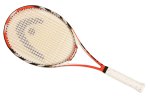 HEAD MICROGEL RADICAL MP
NOW $229 (normally $329)
• Players competition model
• Mid plus head size / 98 sq.ins
• 295g strung weight
• 18/20 string pattern
HEAD FLEXPOINT 6 O/SIZE 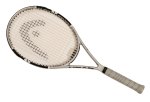
NOW $149 (normally $329)
• Intermediate competition model
• O/size head shape / 102 sq.ins
• 275g strung weight
• Length: 27.5 ins
WILSON (K) ZERO O/SIZE 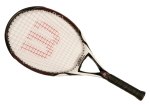
NOW $179 (normally $429)
• Intermediate competition model
• O/size head shape / 118 sq.ins
• 245g strung weight
Just arrived: New tennis racquet ranges for 09/10 season
YONEX RQIS 1 TOUR
NOW $199 (normally $329)
• Ideal for the competition player
• 95 sq.ins head size / isometric shape
• 295g weight
• High modulus graphite construction
PRINCE 03 HYBRID TOUR LITE
NOW $179 (normally $299)
• Ideal for the competition player
• 95 sq.ins head size
• 280g unstrung weight
• 03 Speedport technology
HOW TO: PERFECT YOUR FOREHAND
The key to a perfect forehand is getting yourself in a good position to hit the ball out in front of your body. Good footwear is essential to getting in position quickly – maximising the timing and balance required to play the shot.
It is important to get the racquet back early so you don’t rush the stroke. This early preparation will make it easier to make contact with the ball in front of the body with the correct weight transference into the stroke.
Make sure you follow through and finish the shot with your racquet high over your opposite shoulder.
Sportsmart Tennis Manager and tennis coach, Ray James
CHOOSING THE RIGHT TENNIS RACQUET
Sportsmart Tennis Manager and tennis coach, Ray James
Q. Are there many different kinds of tennis racquet?
There are three major categories of tennis racquets:
- Recreational/game-improver range
- Intermediate/club competition range
- Player performance range
Q. What are some of the main things to think about when selecting a tennis racquet?
The key points to consider are:
– Which category of player am I?
– Do I want more power in my game?
– Do I want more control in my game?
– Do I want a lighter or heavier racquet, and which is going to suit my style of game?
To get more power, choose a tennis racquet with an oversized head or one with a larger ‘sweet spot’.
To gain more control, a smaller mid-sized head and a thinner beam or profile will be helpful.
The swing weight of the tennis racquet, rather than the overall weight, is the more important factor to consider for your requirements. A more ‘head heavy’ swing weight will suit the more competent player, whereas a lighter head or a more evenly balanced racquet will suit the recreational/game-improver player.
I hope these basic tips will assist you in making the right choice when selecting your next tennis racquet. Our friendly and professional staff at Sportsmart are always happy to answer any other questions you may have.
Introducing our new 2009/10 tennis racquet range!
See our full range of HEAD, WILSON, PRINCE, VOLKL, YONEX, BABOLAT & DUNLOP racquets – available at all Sportsmart stores now!
Demo racquets available, either to trial at our in-store hit-up area OR to take home for your weekend hit.
We are proud to have the largest tennis racquet range in Victoria, at the most competitive prices.
Anyone for tennis?
Wimbledon is one of my favourite tennis tournaments of the year – I always have a few late nights watching the best players in the world fight it out on court. I enjoy the combination of skill and strategy, and this also makes it a great sport to play. I like racking up a few games with friends and family on our local tennis courts – though it is slightly discouraging watching the children being coached on the nearby courts, because they tend to have a better forehand than me!
Gerrard Woods
Director, Sportsmart
 blog.sportsmart.com.au